
Defence
Saab Challenges Rafale Deal as India Plans 114 More Jets
Gripen E vs Rafale — lower costs and Make in India promises clash with proven performance and strategic ties as India faces a critical fighter decision.

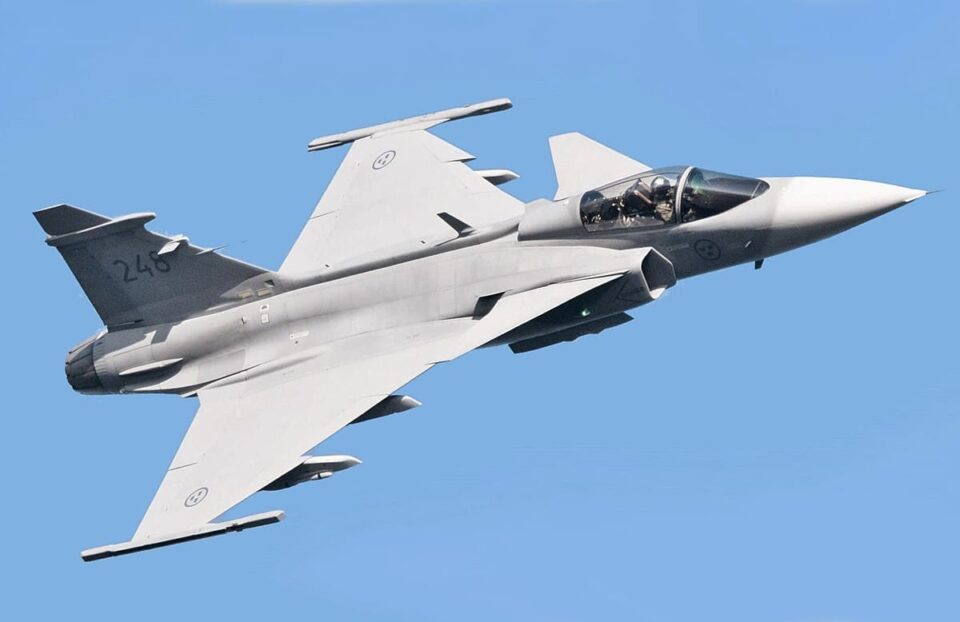
As of February 2026, Sweden’s Saab has launched a bold renewed push to sell the Gripen E to India — and the timing is dramatic. Why? Because India is reportedly close to sealing a massive deal for 114 additional French Rafale jets.
The Indian Air Force is facing serious squadron shortages. Numbers are falling below sanctioned strength, and the need for capable multirole fighters is urgent. Reports suggest India could finalize a government-to-government deal with France for 114 Rafales — possibly advanced F4 or even F5 variants — worth around ₹3.25 lakh crore, roughly 36 to 38 billion US dollars.
Approval could come any time. But just as Rafale momentum builds, Saab steps in aggressively at the Singapore Airshow.
Mikael Franzén, Saab’s Chief Marketing Officer for Gripen, is pitching the Gripen E as the most modern and cost-effective fighter available today. Sleek, agile, digitally advanced — and strategically positioned right between Rafale and Tejas in capability terms.
Saab argues the Gripen E would perfectly complement India’s fleet: Rafale as the heavy, deep-strike powerhouse, Tejas as the indigenous light fighter. Gripen E filling the middle — quick to induct, highly available, and operationally efficient. They emphasize combat mass — meaning more aircraft ready to fly when it matters most.
Alright, now let’s talk numbers — because this is where things get really interesting.
When it comes to acquisition cost, the Gripen E is being pitched at roughly half — or even less — than what India effectively pays per Rafale in a fully bundled package.
Estimates place the Gripen E at around 85 to 146 million dollars per aircraft. Compare that to the Rafale deal. Once you include weapons packages, training, maintenance support, infrastructure, and long-term sustainment — the per-aircraft cost in the Indian context crosses 300 million dollars per jet.
That’s a massive gap. But the real long-term story? Operating costs. This is Saab’s biggest selling point. Gripen E is often quoted at around 4,000 to 10,000 dollars per flight hour, with some higher-end estimates reaching about 22,000.
Rafale, on the other hand, is generally estimated at 14,000 dollars per flight hour or more, depending on mission profile and configuration.
Now imagine operating a fleet of 100-plus aircraft for 30 to 40 years. Those numbers add up — fast. For a large air force, lifecycle cost can matter even more than the sticker price.
But — and this is critical — price isn’t everything. Rafale’s higher cost reflects what it brings to the table. It’s a twin-engine fighter designed for heavier strike missions, capable of carrying larger payloads, and it already has a proven combat track record — including operational experience with the Indian Air Force.
It also symbolizes deep strategic ties between India and France — and in defense procurement, geopolitics always matters. Gripen E takes a different philosophy.
It focuses on high availability rates, easier maintenance, distributed operations, rapid software upgrades, and significant technology transfer. Saab is promising full Make in India participation — local production, sovereign software control, MRO facilities, and involvement of over 300 Indian companies.
They even claim deliveries could begin as early as the third year after contract signing — which is fast in fighter procurement terms.
Right now, momentum appears to favor additional Rafale procurement, potentially through a government-to-government pathway. But Saab’s renewed push shows this competition is far from over.
For more aerospace news, check out JetlineIntel.
Want to buy aviation merchandise? VisitJetshop.in.
To read Jetlinemarvel’s updates on Google News, head over to Google News.
