
Aviation
Does the United States Control China’s C919 Aircraft

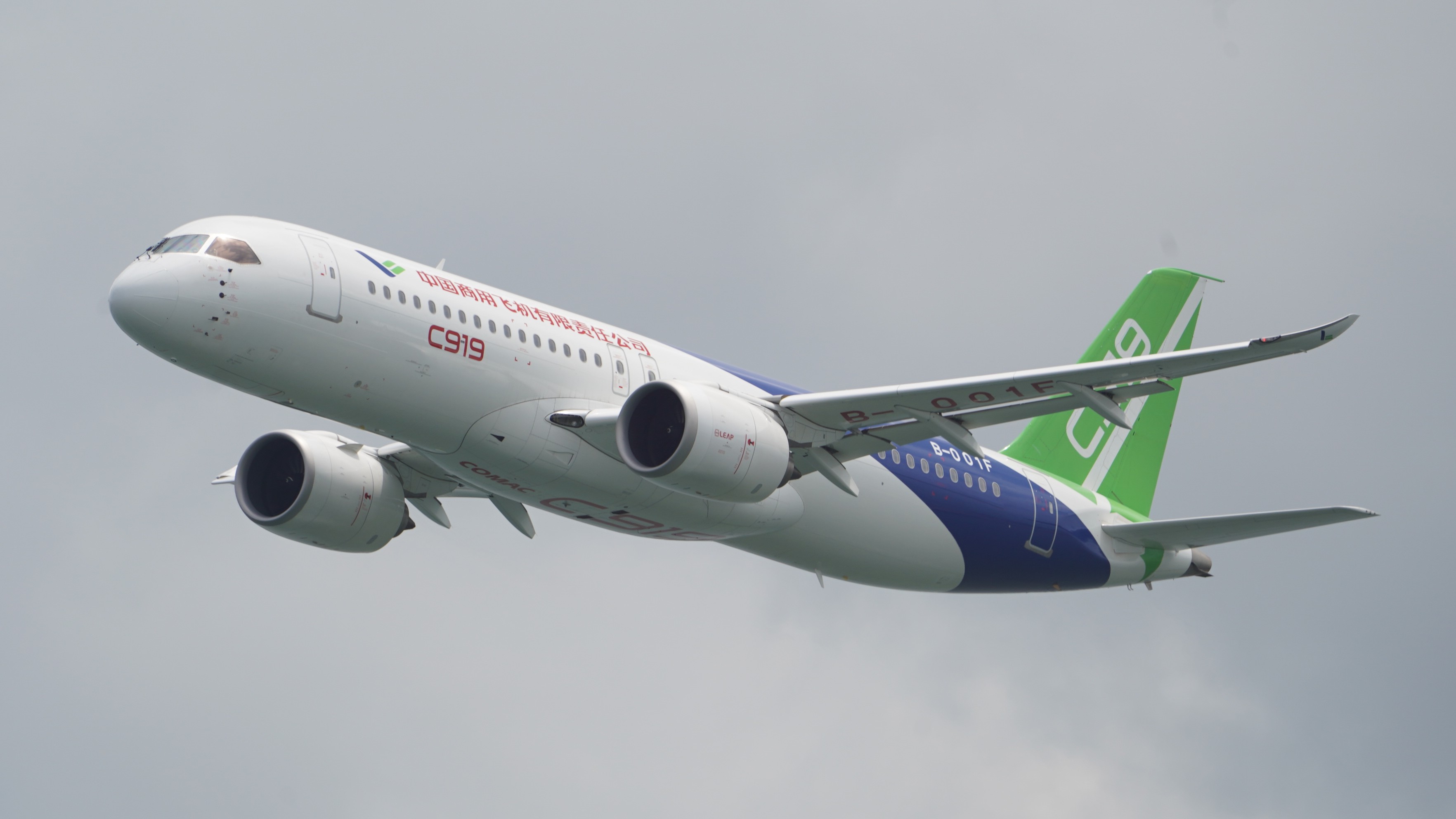
China’s COMAC C919 is drawing growing global attention as it begins to challenge Western-made aircraft. At the Singapore Airshow 2026, the C919 was showcased prominently, placing it directly in comparison with narrow-body jets from Airbus and Boeing.
As the aircraft rapidly becomes dominant within China’s domestic airline market, questions are emerging about its future impact. Could the C919 eventually take meaningful market share away from Western manufacturers? And more importantly, are Western countries still comfortable supplying critical components to an aircraft that could become a long-term competitor?
That leads to the bigger question.
Does the United States actually have control or leverage over the C919 program—despite it being a Chinese-developed aircraft? And if so, how does that influence the aircraft’s production, deliveries, and global ambitions?
In this article, we break down whether U.S. technology, export controls, and certification rules give Washington indirect control over China’s flagship narrow-body jet—and what that means for the future of the global aviation market.
The United States does not have direct control over China’s domestically built COMAC C919 aircraft. Washington does not own, operate, or dictate the design or production of the jet. The C919 is developed by COMAC—the Commercial Aircraft Corporation of China, a state-owned enterprise, and is fully assembled in China.
The aircraft is a narrow-body airliner designed to compete with the Airbus A320 and Boeing 737 families. It can carry up to 200 passengers and entered commercial service in 2023, primarily with Chinese carriers such as China Eastern Airlines.
However, while the U.S. does not control the C919 directly, it does exert significant indirect influence over the program—and that’s where things get interesting.
The Hidden Leverage: Western and U.S. Technology
The C919 relies heavily on Western components, many of which originate in the United States. This dependence creates a vulnerability to U.S. export controls, sanctions, and geopolitical decisions.
The most critical example is the aircraft’s engine. The C919 is powered exclusively by the CFM LEAP-1C turbofan, produced by CFM International, a 50–50 joint venture between U.S.-based GE Aerospace and France-based Safran. Although Safran is European, the engine incorporates substantial U.S. technology, meaning every engine shipment to China requires U.S. export approval.
Export Controls and Production Disruptions
In May 2025, amid escalating U.S.–China trade tensions—particularly over tariffs, critical minerals, and rare earths—the U.S. Commerce Department temporarily suspended export licenses for LEAP-1C engines and other aviation components destined for COMAC.
The impact was immediate. COMAC was forced to rely on stockpiled engines, and C919 delivery targets for 2025 were significantly reduced. Production delays exposed just how sensitive the program is to political shifts.
Although these restrictions were lifted in July 2025 following diplomatic negotiations—allowing engine shipments to resume in early 2026—experts warn that such controls could be reimposed at any time, making the C919 inherently vulnerable to future geopolitical tensions.
Certification: Another Barrier to Global Expansion
China is actively promoting the C919 to international buyers, but certification remains a major obstacle.
To operate in the United States, the aircraft requires FAA certification, while European markets demand approval from EASA. So far, the C919 is certified only by China’s aviation authority, limiting its international reach.
Some Asian and developing countries have shown interest, but no major overseas orders have been finalized. While the aircraft has flown to international destinations—mainly in countries friendly to China—full commercial operations abroad remain restricted.
Global Showcases, Limited Market Access
China continues to aggressively market the C919 on the global stage. The aircraft has appeared at Dubai Airshow and Singapore Airshow, where it has drawn significant attention.
At recent airshows, COMAC allowed the public rare access to the cabin, cockpit, and interior, highlighting passenger comfort and modern avionics. At the Singapore Airshow, visitors—including us—were able to get a close-up look at the aircraft, signaling China’s confidence in the program.
U.S. Suppliers: A Strategic Pressure Point
Beyond engines, the C919 depends on numerous U.S. aerospace suppliers, including companies such as Honeywell and Collins Aerospace, which provide avionics, flight control systems, and software.
Reports suggest the aircraft uses components from around 48 major U.S. suppliers, alongside 26 European suppliers. Many of these parts fall under U.S. export control laws, especially if classified as dual-use technologies with potential civil-military applications. This gives Washington a powerful tool: it doesn’t need to ban the aircraft outright—it can simply pause or deny export licenses, disrupting the supply chain.
China’s Long-Term Escape Plan: A Domestic Engine
To reduce dependence on Western technology, China has been developing its own indigenous engine—the ACAE CJ-1000A—since 2017.
The engine is currently undergoing ground and flight testing and is intended to replace the LEAP-1C in future C919 variants. However, aviation experts agree that certification, reliability validation, and mass production are still years away.
Realistically, full engine independence is unlikely before 2027–2030.
Final Verdict
So, does the United States control China’s C919? Not directly.
But through export controls, critical technology dependencies, engine approvals, and certification barriers, the U.S. holds substantial indirect leverage over the aircraft’s production rate, delivery schedule, and global expansion.
Until China achieves full technological self-reliance, the C919 will remain not just a commercial aircraft—but a geopolitical chess piece in the ongoing U.S.–China rivalry.
For more aerospace news, check out JetlineIntel.
Want to buy aviation merchandise? VisitJetshop.in.
To read Jetlinemarvel’s updates on Google News, head over to Google News.
