
Defence
GE F414 on AMCA: Temporary Solution or Permanent Choice?
AMCA’s early flights rely on the GE F414, but India’s next-gen stealth fighter ultimately needs a more powerful indigenous engine.

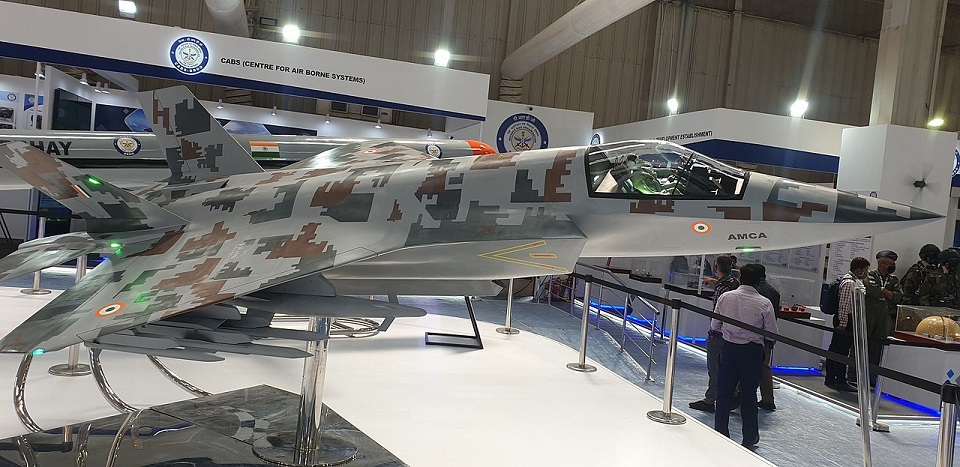
India’s next-generation stealth fighter — the AMCA, or Advanced Medium Combat Aircraft — is slowly moving closer to reality. The prototype is now under development by India’s defense ecosystem, led by HAL along with DRDO and several aerospace partners. But behind the excitement, one major challenge still remains.
The engine.
A fifth-generation fighter is only as powerful as the engine that drives it — and for AMCA, that engine is still evolving.
Initially, India selected the GE F414 engine for early testing and development phases.
This approach is not unusual. Countries like Turkey with the KAAN fighter and South Korea with the KF-21 have also used proven American engines during early development before introducing indigenous powerplants later.
So the big question is —
Is the GE F414 suitable for the AMCA, or is it only a temporary solution?
Let’s understand.
The GE F414 — specifically the F414-GE-INS6 variant — is not unsuitable for AMCA.
In fact, it is a reliable and combat-proven engine. It produces around 98 kilonewtons of thrust with afterburner, and about 57 to 58 kilonewtons in dry thrust. With two engines, the AMCA would generate nearly 196 kilonewtons of total thrust.
However, the AMCA is expected to be a 25-ton class stealth fighter, designed for supercruise — meaning sustained supersonic flight without using afterburners — along with high maneuverability, internal weapons bays, and advanced stealth performance.
And this is where limitations appear.
Many analysts believe the F414’s thrust is slightly marginal for an aircraft of this size and ambition. In India’s hot and high operating environments, engine performance can drop even further, possibly reducing effective thrust during supercruise attempts.
As a result, the aircraft may need to rely more on afterburners for supersonic flight. But afterburners come with problems — higher fuel consumption, shorter combat range, and a stronger infrared signature, which can reduce stealth effectiveness.
For comparison, true fifth-generation fighters like the F-22 use much more powerful engines, allowing sustained supersonic flight using dry thrust alone.
India already has a solution planned.
The F414 will power only the AMCA Mk1, including prototypes and the first production aircraft — roughly the first two squadrons. The future AMCA Mk2 is expected to receive a new, more powerful engine in the 110 to 125 kilonewton thrust class, possibly developed jointly with international partners like France’s Safran alongside India’s GTRE and DRDO.
This new engine aims to deliver true supercruise capability, better thrust-to-weight ratio, and long-term upgrade potential.
There are also strategic concerns.
Dependence on a foreign engine means risks of export restrictions, supply delays, and limited technology transfer.
Any export of an F414-powered aircraft would require approval from the United States — something that conflicts with India’s goal of defense self-reliance under Atmanirbhar Bharat.
Despite these concerns, the F414 was chosen for one important reason:
It works today.
The engine is mature, reliable, and already supported by a global supply chain.
Plans also include significant manufacturing and localization in India through HAL-GE cooperation.
Most importantly, it allows the AMCA program to move forward without waiting decades for a completely new engine. In simple terms, the F414 acts as a bridge engine — enabling India to fly the AMCA sooner while developing its own high-thrust indigenous powerplant.
So in conclusion, the GE F414 is technically adequate for early AMCA development and limited operational use. But for achieving the full vision of a true fifth-generation fighter, India will ultimately need a more powerful, fully indigenous engine.
Because in modern air combat, stealth and avionics matter — but the real heart of a fighter jet… is its engine. And mastering that technology remains one of India’s biggest aerospace challenges.



