
Aerospace
India’s Space Station Dream Takes Shape with Successful Crew Pod Drop Test
ISRO has taken a bold step toward the Bharatiya Antariksh Station by testing crew capsules with a Chinook, showcasing India’s growing space ambitions.

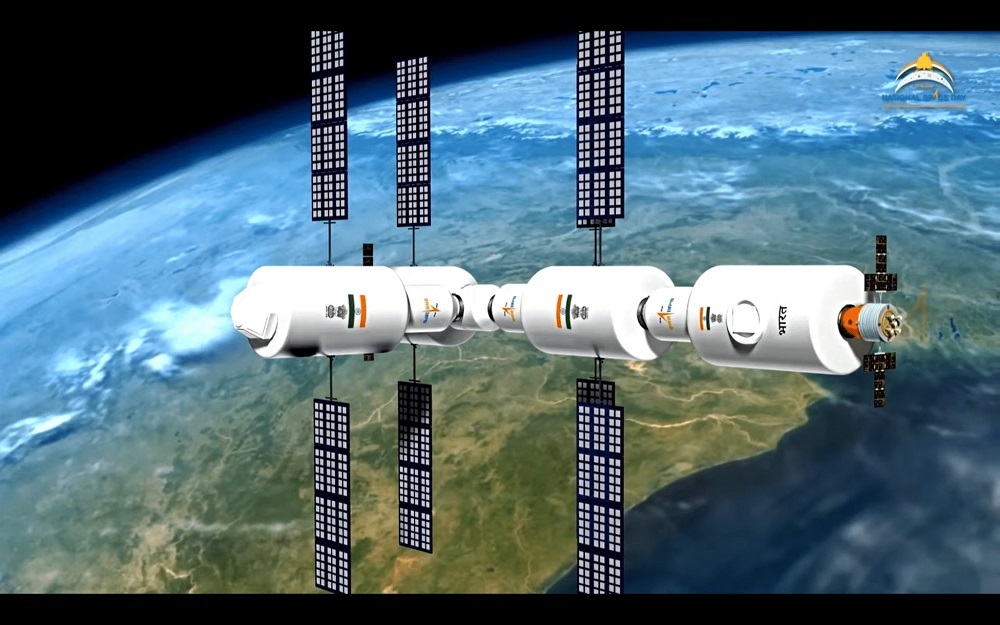
India’s space program, spearheaded by the Indian Space Research Organisation (ISRO), has been on an upward trajectory, with recent announcements highlighting plans to develop an indigenous space station.
This marks a significant evolution from satellite launches and lunar missions to sustained human presence in low Earth orbit. Below, we’ll break down the key aspects of these plans, their timeline, technical details, and broader context, based on official ISRO statements and updates as of 2023–2024.Background and Rationale
Historical Context: India’s space journey began with the launch of its first satellite, Aryabhata, in 1975. Milestones like the Chandrayaan missions (lunar explorations) and Mangalyaan (Mars orbiter in 2013) have built ISRO’s reputation for cost-effective innovation. The Gaganyaan program, India’s first human spaceflight initiative announced in 2018, is the precursor to the space station, aiming to send astronauts to orbit by 2025.
The Bharatiya Antariksh Station (BAS, or Indian Space Station) aligns with India’s goal of becoming a space superpower. It will support microgravity research in biology, materials science, and Earth observation, fostering technological self-reliance (Atmanirbhar Bharat). Globally, it positions India alongside nations like the US (ISS), China (Tiangong), and Russia, enhancing international collaborations while reducing dependence on foreign infrastructure.
Why a Space Station?
Technology Involved & Launch Vehicles
India is now working on next-generation launch vehicles and cargo missions that will support the upcoming Indian space station. The crew modules, derived from the Gaganyaan program, are being designed with re-entry capabilities. These have already undergone uncrewed tests, including the TBD-1 mission in 2013.
Most recently, on 23rd August, ISRO successfully conducted a drop test using a Chinook helicopter. The test capsule, attached with three parachutes, was safely landed in water, meeting all safety standards. Future crew models will feature robotics and AI assistance—such as autonomous docking systems, robotic arms for maintenance, and AI-controlled environmental systems to reduce astronaut workload.
Cockpit systems will include thrust control levers, scientific modules, and advanced docking/undocking mechanisms to operate seamlessly in orbit.
Scientific Goals
The space station will host crucial experiments in:
- Space medicine
- Fluid dynamics
- Climate monitoring
It will also act as a hub for deep-space missions, preparing India for future Mars and Venus probes.
Timeline & Milestones
- 2022–2024: Uncrewed Gaganyaan test flights conducted. Crewed mission with 3 astronauts for a 3–7 day orbital stay is planned for 2024.
- 2025–2028: Launch of the first BAS module (unmanned power and propulsion unit) into orbit.
- By 2030: Full operational status of the Indian Space Station, with crewed habitation modules. ISRO Chairman S. Somanath has confirmed this target, aiming for 80–90% indigenous components.
Challenges Ahead
- Budget constraints: $1.5 billion vs NASA’s $25 billion annual space budget.
- Technological hurdles: life-support systems, international sanctions on tech transfer.
- Resource limits: ensuring safe human spaceflight in cost-efficient ways.
Despite this, India is building one of the world’s most affordable orbital stations, setting it apart in global space economics.
Economic Impact
- Estimated cost: $2–5 billion over a decade.
- Benefits: job creation in aerospace, spinoffs in telemedicine and agriculture, boosting India’s $10 billion space economy, and attracting private investments.
Geopolitical Angle
Amid the US-China space rivalry, India’s BAS project highlights a neutral yet assertive stance. It could strengthen partnerships with nations like Brazil and South Africa, promoting South-South cooperation.
Optimism & Future Prospects
With ISRO’s proven track record—like the successful Chandrayaan-3 landing on the lunar south pole in 2023—the dream of BAS looks achievable. If successful, India will become the fourth nation to operate its own space station, inspiring new global innovations.
Beyond research, it could also pave the way for space tourism and commercial missions in the coming decades.
Final Thought
So, what do you think? Will the Bharatiya Antariksh Station (BAS) be India’s biggest breakthrough in space exploration? Share your views in the comments below.
For more aerospace news, check out JetlineIntel.
Want to buy aviation merchandise? Visit Jetshop.in.
To read Jetlinemarvel’s updates on Google News, head over to Google News.
