
Defence
What is the Role of the Small Canard Wing on the Tejas Mk-II?
The canard wings on the Tejas Mk-II play a crucial role in improving maneuverability, stability, and lift, elevating its performance in both air combat and multirole missions.

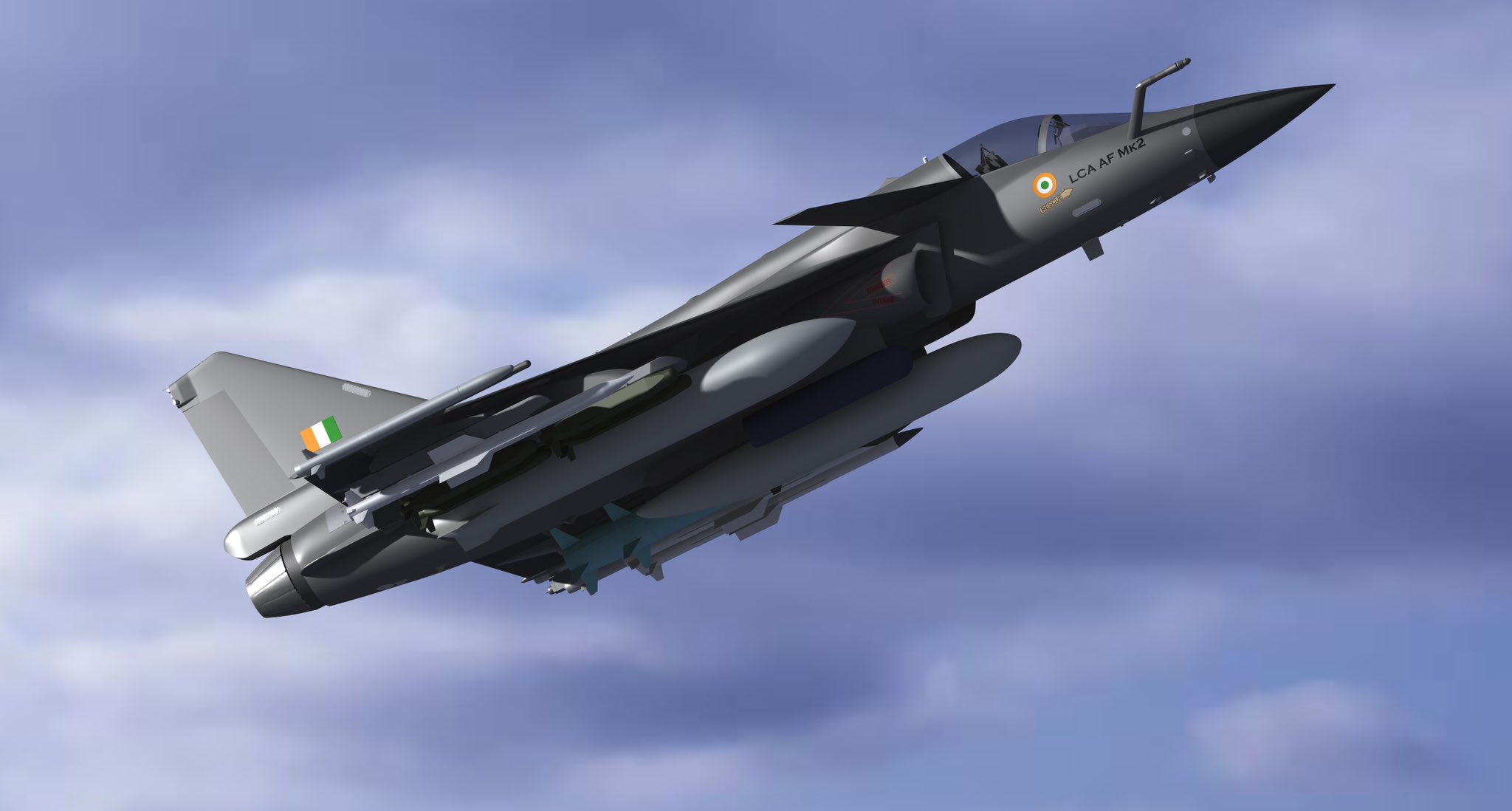
If you look closely at the images, you’ll notice a small wing plate near the nose, just below the cockpit—this is where the canards are attached. This feature is part of a canard delta-wing configuration, a design commonly seen in advanced modern fighter jets.
The addition of canards brings a significant boost in agility, rapid-turn capability, and overall aerodynamic performance.
In this article, we’ll explore how the canard delta-wing design enhances the strength and versatility of the HAL Tejas Mk-II. Unlike the earlier Tejas Mk-I and Mk-III variants, which used a pure delta-wing layout, the Mk-II features close-coupled canards—small forward wings placed just ahead of the main delta wing.
This configuration provides several aerodynamic and operational advantages. It increases maneuverability, enhances lift during high-angle-of-attack situations, and improves stability and control at both low and high speeds.
These improvements make the Tejas Mk-II more agile, more responsive, and significantly more capable—elevating it firmly into the class of 4.5-generation multi-role fighter jets with enhanced combat effectiveness.
Furthermore, the canard configuration significantly enhances lift and aerodynamic efficiency. By generating additional lift and creating a high-pressure zone beneath the canards, they interact with the main delta wing to produce stronger vortex flows.
This vortex interaction system increases the overall lift coefficient, enabling the Tejas Mk-II to carry a heavier payload—up to 6,500 kg, compared to 3,500 kg on the Mk1A. It also allows the aircraft to operate efficiently at higher angles of attack and improves low-speed performance.
Canards are particularly effective in boosting lift during low-speed flight, which greatly enhances take-off and landing performance.
This is especially important for operations from shorter runways or, potentially, aircraft carriers—should the Mk-II be adapted for naval use. The canards help reduce take-off distance and landing speed compared to the Mk1A.
A key aerodynamic benefit of the close-coupled canard layout is the generation of vortices that energize the airflow over the main delta wing.
These vortex interactions delay flow separation, improving stability and control at high angles of attack. This is crucial for dogfighting, high-agility maneuvers, and maintaining control in extreme airstream conditions.
Additionally, the canard delta-wing serves as an effective control surface, offering precise pitch control by generating controlled pitching moments.
This design enables smooth take-offs at high angles of attack. The delta-wing configuration allows the latest Mach-2 Tejas Mk-II to achieve a maximum angle of attack close to 28 to 30 degrees, compared to around 24 degrees for the Mk1A.
It also helps reduce drag during maneuvers by optimizing airflow over the wing, minimizing induced drag even at high angles of attack, up to 90 degrees for the Mk-II.
The canard delta-wing design introduces controlled static instability, which improves the aircraft’s agility and responsiveness.
This instability is carefully managed by the digital flight control system, which coordinates the canards and other control surfaces to maintain overall stability. This allows the pilot to fully exploit the aircraft’s enhanced maneuverability without compromising control.
The enhanced payload capacity of the Tejas Mk-II, enabled by the canard delta-wing design, allows it to carry up to 6,500 kg across 11 hardpoints. This supports a wide variety of weapons, including SPAR, BBR missiles, BrahMos, machine guns, and precision-guided munitions.
With improved lift-to-drag ratio and optimized fuel efficiency during cruise, the Mk-II boasts an extended combat radius of 2,000 km without refueling. Its mission endurance is approximately 120 minutes, nearly 57 minutes longer than the Mk1A, making it well-suited for deep strike and long-range missions.
The canard delta-wing configuration also enhances the aircraft’s versatility, enabling it to excel in multiple roles such as air superiority, ground attack, and reconnaissance. Improved lift and control allow the Tejas Mk-II to carry heavy weapon loads while maintaining superior agility and maneuverability.
When comparing the canard delta-wing of the Tejas Mk-II with other aircraft, it’s clear that the design draws inspiration from successful fighters like the Saab JAS-39 Gripen, Dassault Rafale, and Eurofighter Typhoon, all of which use similar configurations to enhance agility and support multi-role missions.
However, the tejas mk2s close-coupled canards are specifically optimized for a higher lift-to-weight ratio (about 0.5 tons) and a more cost-effective design, delivering comparable performance with lower acquisition and operating costs.
That said, there are challenges and considerations with this configuration. The canard delta-wing increases design complexity compared to the simpler delta-wing of the Mk1A. Integrating canards requires highly precise tuning of the flight control system to prevent instability.
Additionally, tejas mk2 manufacturing private sector participation,while the canards contribute to lift, they also add weight to the airframe. This weight penalty must be carefully balanced with the power of the F414 engine and optimized aerodynamics to ensure overall performance and manageable maintenance demands.
The canard delta-wing configuration is a game-changer for the Tejas Mk-II, transforming it into a highly maneuverable, versatile, and semi-stealthy 4.5-generation fighter.
This design significantly enhances lift, agility, and control, enabling superior performance in air combat, ground strike, and reconnaissance missions. Combined with advanced avionics, a powerful engine, and reduced radar cross-section (RCS), the Tejas Mk-II emerges as a formidable competitor to aircraft like the Gripen and JF-17.
Supporting India’s goal of defense self-reliance, the Tejas Mk-II is on track for its first flight in 2026. The canard delta-wing configuration will be critical in meeting the Indian Air Force’s operational demands across the diverse and challenging regional environment.



