
Defence
KF-21 Block 2 & 3 Explained: How South Korea Is Building a Stealth Fighter
KF-21 Block 2 adds multirole strike power, while Block 3 introduces stealth, internal weapons bays, and drone teaming — transforming South Korea’s fighter into a near fifth-generation aircraft.

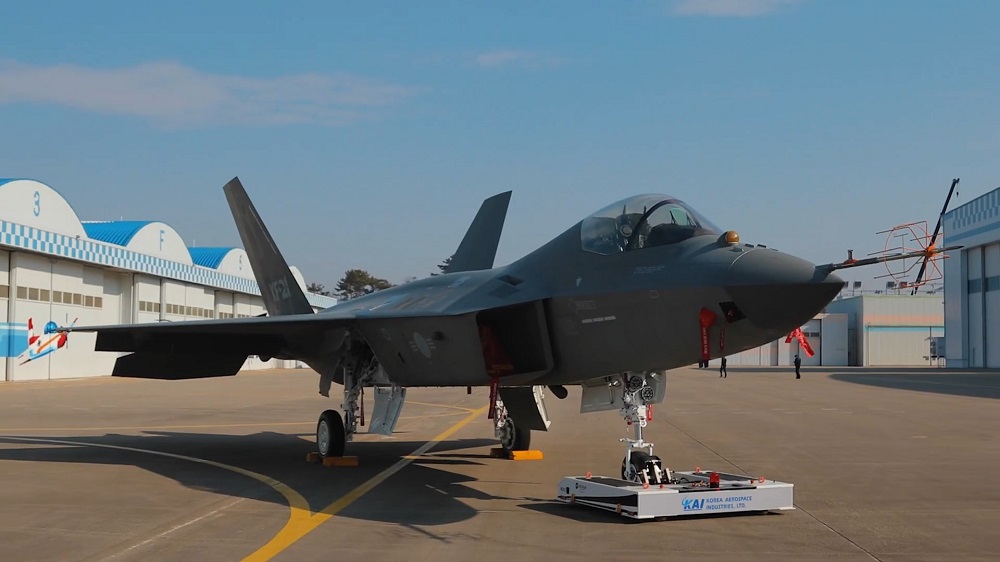
South Korea has formally unveiled the first series-produced KF-21 Boramae fighter jet, marking a major milestone achieved just a few years after the aircraft’s maiden flight — a development pace rarely seen in modern combat aviation.
Korea Aerospace Industries (KAI) rolled out the production aircraft on March 25, 2026, at its manufacturing facility in Sacheon, South Gyeongsang Province, in the presence of President Lee Jae Myung. The event symbolized both the culmination of decades of technological ambition and the beginning of a new phase for South Korea’s defence industry.
During the ceremony, President Lee described the fighter as the realization of a long-standing national goal of achieving self-reliant air defence capability.
A 25-Year Journey to Indigenous Airpower
The KF-21 program traces its roots back to 2001, when former President Kim Dae-jung first proposed developing a domestically built combat aircraft. However, the project gained real momentum in 2016, when South Korea launched the full system development phase.
At that time, the country already possessed nearly 87 percent of the required technologies, supported by critical technology transfers from the United States.
KAI unveiled the first prototype in 2021, followed by the aircraft’s maiden flight in 2022. In a remarkable achievement, the first production aircraft emerged less than five years later — an unusually fast timeline compared with other modern fighter programs.
Bridging the Gap Between 4th and 5th Generation Fighters
The KF-21 is a twin-engine, twin-seat 4.5-generation multirole fighter, designed to bridge the technological gap between traditional fourth-generation jets and full stealth fifth-generation aircraft while maintaining lower acquisition costs than platforms such as the F-35.
Developed as a joint program between South Korea and Indonesia, Jakarta initially held a 20 percent stake, although its participation has been scaled back due to financial constraints.
The aircraft is expected to become the backbone of the Republic of Korea Air Force (RoKAF) and play a central role in South Korea’s “three-axis defence system,” aimed at deterring threats from North Korea.
Rapid Evolution Toward Fifth-Generation Capabilities
Although officially classified as a 4.5-generation fighter, South Korean officials argue the KF-21’s capabilities place it closer to fifth-generation performance.
KAI CEO Kang Goo-Young has previously suggested the aircraft could be considered a “4.9-generation fighter,” claiming performance advantages over aircraft such as the Rafale and Eurofighter Typhoon, though it currently lacks full stealth characteristics.
South Korea plans to upgrade the aircraft through a phased block development strategy, culminating in Block III (KF-21EX). Future enhancements are expected to include:
- Internal weapons bays
- Improved stealth shaping and coatings
- Indigenous engine development
- Integration with loyal-wingman drones
- Advanced sensors and networked warfare systems
Funding for these upgrades has reportedly been included in the country’s 2026 defence budget.
If internal weapons bays are added, the KF-21 could eventually be reclassified as a true fifth-generation fighter, potentially making South Korea the fourth nation to field such an aircraft after the United States, Russia, and China.
Fastest Development Timeline Among Modern Fighters
The KF-21’s progress stands out when compared with other next-generation fighter programs worldwide.
- The X-35, precursor to the F-35, first flew in 2000, while the first production F-35 appeared in 2011 — an 11-year gap.
- Russia’s Su-57 flew in 2010 but reached production only in 2020, taking roughly a decade.
By contrast, South Korea moved from first flight to production rollout in under five years, setting a new benchmark for development speed.
Ahead of AMCA and KAAN Programs
The KF-21 has also advanced more quickly than several contemporary indigenous fighter programs.
India’s Advanced Medium Combat Aircraft (AMCA), launched in 2010 under the Aeronautical Development Agency and DRDO, received full engineering approval only in 2024. The first prototype is expected in 2027, with a maiden flight planned for 2028 and operational induction projected between 2034 and 2035.
Turkey’s KAAN fighter has progressed faster than AMCA, rolling out its prototype in 2023 and achieving its first flight in 2024. Additional prototypes are expected to enter testing in 2026, while serial production is planned around 2028.
Export Ambitions and Global Defence Expansion
South Korea’s defence industry has rapidly expanded in recent years, ranking 10th among global arms exporters between 2020 and 2024, according to SIPRI data. The country increased its global market share from 0.9 percent to 2.2 percent during that period.
Seoul is already marketing the KF-21 internationally, with reported interest from: United Arab Emirates, Saudi Arabia, Philippines and Poland. The aircraft aims to provide a cost-effective alternative in the advanced fighter market while complementing South Korea’s existing F-35 fleet.
A Strategic Turning Point
The rollout of the KF-21 represents more than a new aircraft — it signals South Korea’s arrival as a major aerospace and defence power capable of designing, testing, and producing advanced combat systems on accelerated timelines.
As President Lee emphasized during the ceremony, South Korea now possesses domestically developed systems capable of defending the nation across land, sea, and air — and intends to share both technology and experience with international partners.
With production underway and future upgrades already planned, the KF-21 Boramae may become one of the most influential fighter programs shaping the global defence market in the coming decades.
For more aerospace news, check out JetlineIntel.
Want to buy aviation merchandise? VisitJetshop.in.
To read Jetlinemarvel’s updates on Google News, head over to Google News.



