
Defence
Can Tejas Mk-2 Challenge Rafale’s Reign? India’s DRDO Sounds Confident
Tejas Mk-2 is poised to match Rafale with advanced sensors and Indian weapons, but can it truly outpace the combat-proven French jet?

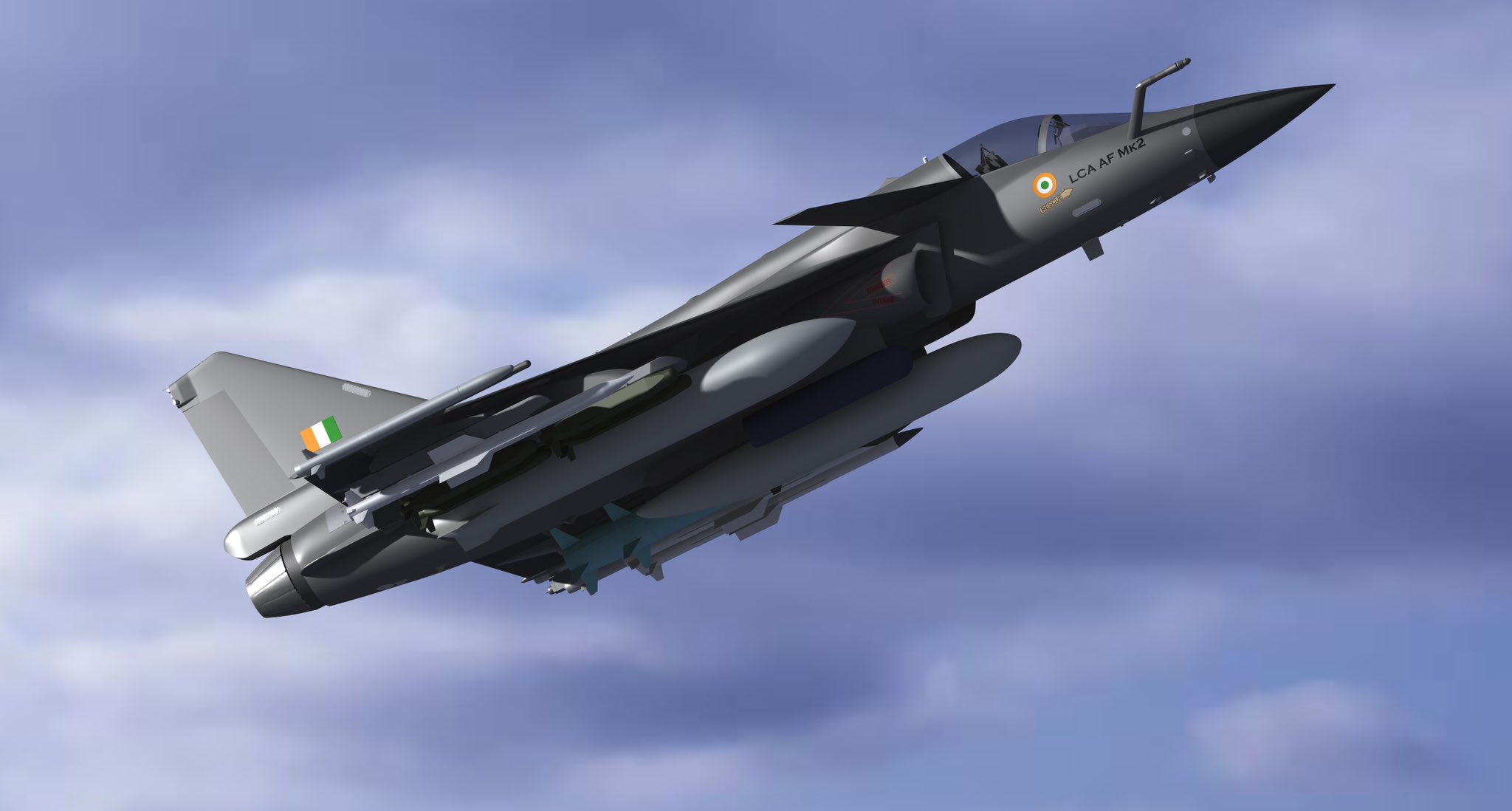
As India accelerates its journey towards defense self-reliance, a new symbol of indigenous aerospace ambition is preparing for flight — the HAL Tejas Mk-2.
Set to replace ageing fighters like the Mirage 2000, MiG-29UPG, and Jaguars in the Indian Air Force (IAF), the Tejas Mk-2 is being touted as India’s answer to world-class multirole jets.
In a bold declaration, DRDO has claimed that the Tejas Mk-2 will match, and potentially exceed, the capabilities of the French Rafale — currently the IAF’s most advanced fighter platform. But as this bold claim captures headlines, a crucial question arises: Can the Tejas Mk-2 truly rival, or even surpass, the battle-hardened Rafale?
DRDO’s Vision for a Game-Changer
Speaking at a defense symposium in Bengaluru, Dr. Ravi Shankar S.R., a senior DRDO scientist, stated that the Tejas Mk-2 — backed by indigenous technologies and cost-effective manufacturing — is poised to match the Rafale’s capabilities across multiple parameters.
He highlighted the aircraft’s advanced avionics, cutting-edge radar, and Indian-designed electronic warfare systems as pillars of its strength.
While the statement sparked optimism in India’s defense circles, several military analysts have weighed in with both enthusiasm and caution, pointing to the aircraft’s delayed development timeline and the evolving benchmarks set by Dassault Aviation’s Rafale variants.
Features of the Tejas Mk-2: India’s Homegrown Powerhouse
Here’s what sets the Tejas Mk-2 apart as a next-generation 4.5-gen multirole fighter:
- Engine & Performance:
Powered by the GE F414-INS6 engine, delivering 98 kN of thrust, enabling higher speed, improved climb rates, and agility over its predecessor. - Increased Size & Payload:
A larger airframe allows for 6,500 kg payload capacity, making it ideal for multi-role combat missions. The aircraft also boasts a combat range of 2,500 km with external tanks. - Advanced AESA Radar:
Developed by DRDO’s LRDE, the indigenous Active Electronically Scanned Array (AESA) radar offers detection ranges of up to 200 km for fighter-sized targets — comparable or superior to the Rafale’s Thales RBE2-AA radar. - Electronic Warfare Suite:
Features a DRDO-developed digital radar warning receiver, jammers, and Infrared Search and Track (IRST), tailored for threats like China’s J-20 and Pakistan’s JF-17. - Weapon Systems:
Supports a wide array of indigenous armament, including:- Astra Mk-2 & Mk-3 BVR missiles (150–300+ km range)
- BrahMos-NG air-launched cruise missile
- Precision-guided munitions and smart bombs
- Agility & Maintenance:
Weighing 13.5 tons, it is lighter than the Rafale (15.3 tons), promising better maneuverability and lower maintenance costs. Its indigenous supply chain reduces dependency on foreign OEMs.
Rafale: A High Bar to Surpass
The Rafale F3R, currently in service with the IAF, is a battle-proven platform with India-specific enhancements, including:
- Meteor air-to-air missiles
- SCALP cruise missiles
- Advanced EW systems
- Hammer precision bombs
With the F4 upgrade now operational and F5 under development, Rafale’s roadmap includes:
- GaN-based AESA radar
- Hypersonic missile integration
- Enhanced AI-driven systems
- Manned-unmanned teaming as part of Europe’s FCAS program
These upgrades make Rafale a moving target, continuously pushing forward the standard of 4.5-generation fighters.
The Challenges Facing Tejas Mk-2
Despite its promise, the Tejas Mk-2 faces significant delays. Initially set for a 2023 first flight, this has now been deferred to late 2026, with full operational induction unlikely before 2031. Meanwhile, the IAF remains reliant on older jets like the Jaguar, which experienced multiple crashes in 2025 alone.
The F414 engine certification, global supply chain disruptions, and integration of indigenous systems remain critical bottlenecks.
Final Verdict: A Leap Forward, But Not a Leap Ahead (Yet)
If DRDO and HAL deliver the Tejas Mk-2 as envisioned, it could rival earlier variants of the Rafale in cost, technology, and adaptability for Indian conditions. Its compatibility with India’s indigenous weapons, potential for rapid upgrades, and lower operational costs make it a strategic asset.
However, surpassing the Rafale F3R — or the upcoming F5 — will be an uphill battle, given the French jet’s maturity, combat history, and future upgrade path.
Still, the Tejas Mk-2 is not merely about competing — it’s about building sovereignty, reducing foreign dependency, and fueling India’s aerospace ambitions. Whether it matches or exceeds the Rafale, its real value lies in paving the path for future Indian fighters — designed, developed, and deployed by India.
For more aerospace news, check out JetlineIntel.
Want to buy aviation merchandise? Visit Jetshop.in.
To read Jetlinemarvel’s updates on Google News, head over to Google News.



