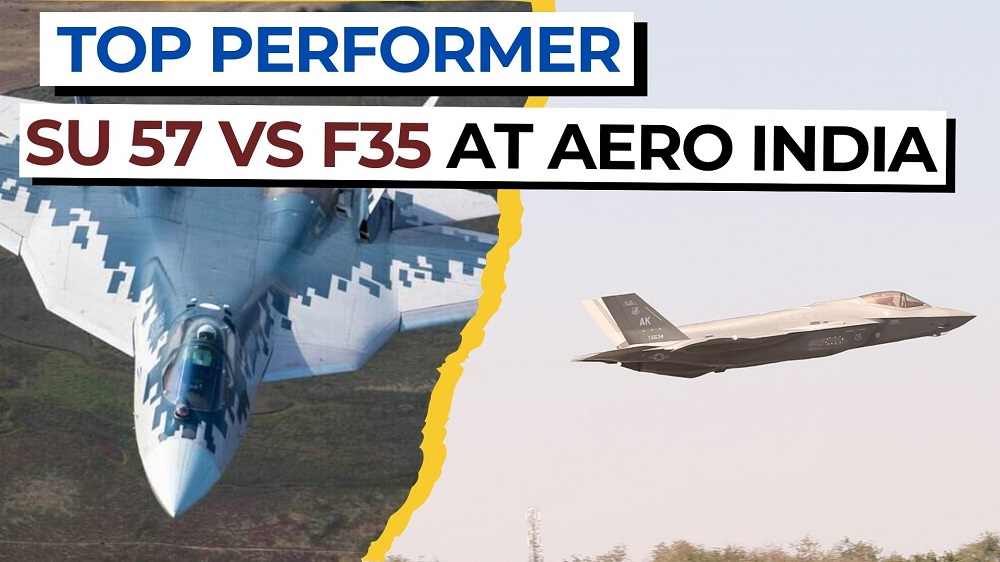
Aero India has officially kicked off, showcasing some of the most advanced fighter jets at the airshow in Bangalore. For the second time, Russia has displayed its fifth-generation fighter jet in India, following its participation in China’s Zhuhai Airshow in 2024.
The su-57 vs f-35 stand out due to their advanced technology, stealth capabilities, extensive weapon-carrying capacity, and ability to execute long-range missions deep into enemy territory.
India, meanwhile, continues to face challenges in developing its own 5th generation fighter jet due to a lack of reliable engines. In response, both the United States and Russia have expressed interest in offering their fighter jet proposals.
The Su-57, Russia’s first fifth-generation fighter, boasts high operational ceilings and advanced combat capabilities. Russia has also proposed assisting India in the development of its indigenous AMCA fighter jet, including its engine development.
On the other hand, the F-35 has 5th generation fighter jets India for the past three years. The U.S. has expressed its willingness to provide extensive support to bolster India’s air force, particularly in countering threats from Pakistan and China. Additionally, the U.S. has offered India the upgraded versions of the F-16, a fighter jet also operated by Pakistan.
At the airshow, both nations demonstrated their aerial power with aggressive maneuvers and dynamic flight displays. The specifications of both aircraft are as follows:
Feature
Su-57 (Russia)
F-35 (USA)
Generation
5th Gen
5th Gen
Role
Multirole Stealth Fighter
Stealth Multirole Fighter
Stealth
Moderate
High
Speed
Mach 2.0
Mach 1.6
Range
~3,500 km
~2,200 km
Weapon Capacity
12 Hardpoints (internal & external)
8 Hardpoints (internal & external)
Avionics
Advanced AESA radar, IRST
Cutting-edge AESA radar, sensor fusion
Maneuverability
Supermaneuverable with thrust vectoring
Superior avionics, data fusion
Operational Use
Limited production, used by Russia
Mass-produced, operated by multiple allies worldwide
On the other hand, the AMCA mock-up was also showcased at the airshow, impressing attendees with its sleek design, internal weapon bay, and advanced avionics. However, the biggest challenge remains its engine, which is expected to be ready for testing by the end of 2028.
India has signed an agreement with the U.S. for engine manufacturing and assembly within the country. However, due to various factors, the engine has yet to arrive in India. Additionally, delays in HAL’s testing programs for the Tejas Mk2 and AMCA have further slowed progress. India is currently considering the GE F404 and GE F414 engines for its fighter jet development.