
Defence
40 Russian Stealth Fighters Could Soon Join the IAF
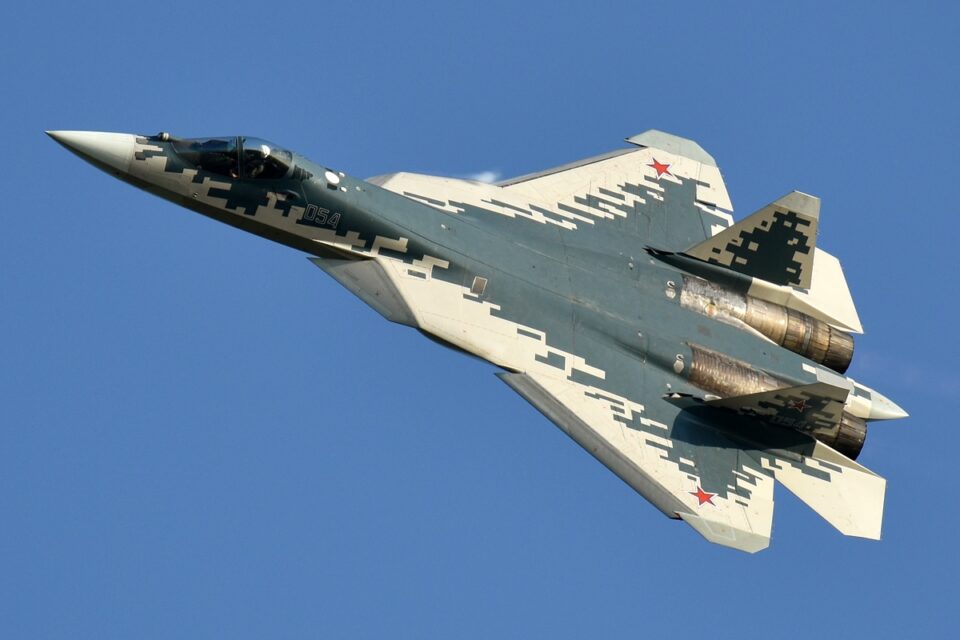
India is likely to move forward with the purchase of 40 Sukhoi Su-57E stealth fighter jets from Russia in a deal that may include source code access and domestic production.

India is pushing ahead with its vision of Aatmanirbhar Bharat, steadily expanding its defence and aerospace ecosystem to reduce long-term dependence on imports.
In that direction, New Delhi is now likely to move forward with the purchase of around 40 Sukhoi Su-57E stealth fighters from Russia — a deal that could also include access to the aircraft’s source code and local production in India. If approved, it would mark one of the most significant Indo-Russian defence collaborations in recent years.
The proposal is expected to be reviewed by the Defence Acquisition Council, which may clear an initial off-the-shelf purchase of 40 aircraft. This could act as a precursor to a larger licensed production programme of over 100 fighters in partnership with United Aircraft Corporation.
The model would mirror India’s earlier procurement of the Su-30MKI, where initial imports were followed by large-scale production at Hindustan Aeronautics Limited facilities in India.
What Makes the Su-57 Significant?
The Su-57 is Russia’s fifth-generation stealth fighter designed for air superiority and deep strike missions. It is powered by twin engines that allow it to exceed Mach 2 in speed, giving it a top speed of over 2,000 km/h. The aircraft has a combat range of roughly 1,500 kilometers without refueling, which can be extended with aerial refueling support.
It can carry a payload of around 10 tons of weapons, including air-to-air missiles, precision-guided bombs, and long-range cruise missiles, many of which are housed internally to preserve stealth. Advanced avionics, sensor fusion, and supermaneuverability are among its defining features. Access to the source code would allow India to integrate indigenous weapons, sensors, and electronic warfare systems — a major boost for domestic defence innovation.
Strategic and Geopolitical Calculations
The Su-57 is currently viewed as India’s only near-term fifth-generation option. American fighters such as the F-35 Lightning II remain politically sensitive and come with operational restrictions, while Chinese platforms are ruled out due to ongoing border tensions.
The aircraft has already entered export service, with Algeria reportedly becoming the first foreign operator in late 2025. Russia has also hinted at additional Middle Eastern contracts, with speculation pointing toward Iran.
At the same time, India recently concluded a major deal for 114 Dassault Rafale jets from France, a 4.5-generation platform. While the Rafale strengthens India’s current capabilities, the Su-57 would represent a leap into the stealth domain.
However, the potential purchase carries geopolitical risks. A deal with Moscow could invite scrutiny under the U.S. Countering America’s Adversaries Through Sanctions Act (CAATSA), placing New Delhi in a delicate balancing act between strategic autonomy and global partnerships.
If finalized, the agreement would not only enhance India’s airpower but also deepen its defence-industrial cooperation with Russia — reinforcing India’s ambition to build, modify, and sustain advanced combat aircraft on its own soil.
For more aerospace news, check out JetlineIntel.
Want to buy aviation merchandise? VisitJetshop.in.
To read Jetlinemarvel’s updates on Google News, head over to Google News.



