
Defence
IAF Begins Super Sukhoi Program to Transform 200 Su-30MKI Fighters into 4.7-Gen Platforms
The IAF’s Super Sukhoi program will upgrade 75% of its Su-30MKI fleet with next-gen AI, advanced radar, and indigenous systems,

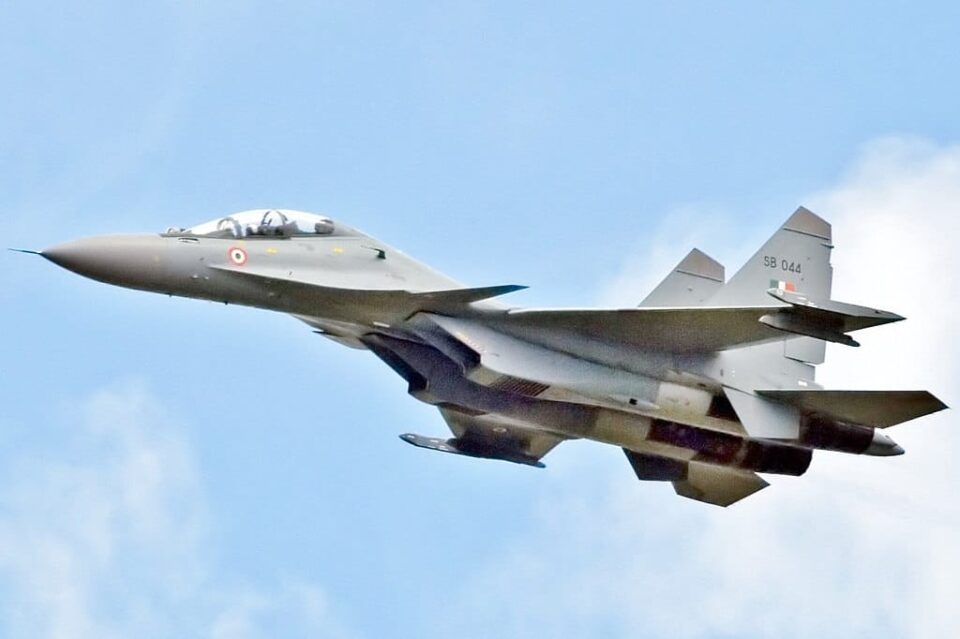
In a landmark stride toward self-reliance and technological supremacy, the Indian Air Force (IAF) has officially launched one of its most ambitious fighter modernisation programs — the “Super Sukhoi” upgrade.
Under this initiative, nearly 75% of the IAF’s Su-30MKI fleet, around 200 aircraft, will be transformed into 4.7-generation multi-role fighters, equipped with AI-enabled cockpits, state-of-the-art electronic warfare systems, and the indigenously developed Virupaksha AESA radar.
This marks a turning point for India’s aerial combat capability — evolving the Su-30MKI from a 1990s-era workhorse into a formidable 21st-century networked fighter, capable of taking on stealth adversaries like China’s J-20 and Pakistan’s JF-17 Block III.
The Backbone of the IAF: Su-30MKI Fleet
The Sukhoi Su-30MKI, jointly developed by Russia’s Sukhoi and India’s Hindustan Aeronautics Limited (HAL), remains the backbone of India’s fighter fleet, with over 270 aircraft currently in service.
Each Su-30MKI is a twin-engine, twin-seater multirole fighter, renowned for its range, payload capacity, and agility. It can perform air superiority, deep-strike, and maritime strike missions with precision.
The upcoming Super Sukhoi upgrade will ensure these jets remain relevant, reliable, and combat-ready well into the 2050s, forming a bridge between India’s current fleet and future platforms such as the Tejas Mk-II and Advanced Medium Combat Aircraft (AMCA).
The Super Sukhoi Transformation: Key Upgrades
The “Super Sukhoi” program — also dubbed “Super-30” — is more than a mid-life upgrade; it’s a complete rebirth of the Su-30MKI.
Here are the core modernization highlights:
1. Virupaksha GaN AESA Radar
- Developed by DRDO’s LRDE, the Virupaksha AESA radar features over 2,400 Gallium Nitride (GaN) Transmit/Receive Modules (TRMs).
- It offers detection ranges beyond 300 km and can track stealth aircraft with low radar signatures up to 200 km away.
- This marks a quantum leap over the older Russian N011M Bars radar, bringing the jet’s situational awareness on par with advanced 4.5+ gen fighters.
2. AI-Infused Cockpit & Wide Area Display (WAD)
- The cockpit will feature a panoramic WAD and AI-assisted mission computer to reduce pilot workload.
- AI will handle functions like threat prioritization, navigation, and sensor fusion, giving pilots real-time decision-making assistance.
3. Advanced Electronic Warfare Suite
- A new indigenous Airborne Self-Protection Jammer (ASPJ) will provide adaptive jamming against enemy radars and missiles.
- The system ensures higher survivability in contested airspace through multi-band countermeasures and improved situational response.
4. Upgraded Digital Flight Control Computer (DFCC)
- Drawing from the Tejas Mk-II’s advanced flight control technology, the new 64-bit DFCC will improve agility, safety, and flight precision.
- Enhanced computing architecture ensures better control responsiveness and reliability under complex mission loads.
5. Infrared Search and Track (IRST) System from Tejas Mk-II
- The new IRST will allow passive detection of enemy aircraft without radar emissions — vital for stealth operations.
- It enhances tracking accuracy in both day and night missions.
6. Enhanced Weapons Integration
- The Su-30MKI will be reconfigured to deploy BrahMos-NG supersonic cruise missiles, Astra Mk-II & Mk-III BVRAAMs, and Rudram anti-radiation missiles.
- These will dramatically extend its air-to-air and air-to-ground reach, making it a lethal platform across mission profiles.
AI and Networked Warfare
The Super Sukhoi’s AI-enabled architecture will enable Manned-Unmanned Teaming (MUM-T) — allowing the aircraft to coordinate with drones and unmanned systems in complex battle environments. This is a crucial step toward the IAF’s future combat vision, where human pilots command drone swarms and autonomous strike elements in synchronized missions.
Indigenisation & Self-Reliance: 80% Local Content Target
Air Chief Marshal Amar Preet Singh emphasized that the Super Sukhoi initiative is not merely about performance but also self-reliance. The project aims for 70–80% indigenisation, with critical collaboration among HAL, DRDO, and private defence firms.
This will mark one of India’s largest domestic modernization programs, valued at ₹60,000–₹70,000 crore, creating a massive boost for the Atmanirbhar Bharat initiative and domestic defence manufacturing.
Timeline and Implementation
- Phase 1 (Post-2030): HAL Nashik will begin upgrades on the first 84 aircraft.
- Phase 2 & 3: Expansion to the remaining fleet, completing nearly 200 aircraft by the mid-2030s.
- Annual Rate: 12–15 aircraft will undergo conversion once the assembly line stabilizes.
- Engine Overhauls: Carried out at HAL Koraput facility in parallel.
IAF Chief’s Vision
Speaking at the press meet ahead of Air Force Day, Air Chief Marshal Singh stated:“This isn’t just an upgrade; it’s a rebirth that keeps us ahead in the Indo-Pacific chessboard.”
He highlighted that the enhanced Su-30MKIs will strengthen India’s deterrence posture across air superiority, deep-strike, and maritime domains — ensuring the IAF remains a decisive force in the region.
The Future: 4.7-Generation Powerhouse
When complete, the Super Sukhoi will emerge as a 4.7-generation fighter, blending the best of legacy Russian airframe strength with cutting-edge Indian electronics and AI capabilities.
It will seamlessly integrate into the IAF’s networked combat environment, operating alongside Rafales, Tejas Mk-II, and AMCA fighters — forming a multi-layered and future-ready air dominance fleet.
For more aerospace news, check out JetlineIntel.
Want to buy aviation merchandise? Visit Jetshop.in.
To read Jetlinemarvel’s updates on Google News, head over to Google News.
