
Defence
Su-57’s New Engine Takes Flight: How Izdeliye-177 Improves on Older Powerplants
The Su-57 has entered a new phase as Russia conducts the first flight of the Izdeliye-177 engine, aiming to enhance performance, survivability, and export appeal of its stealth fighter.

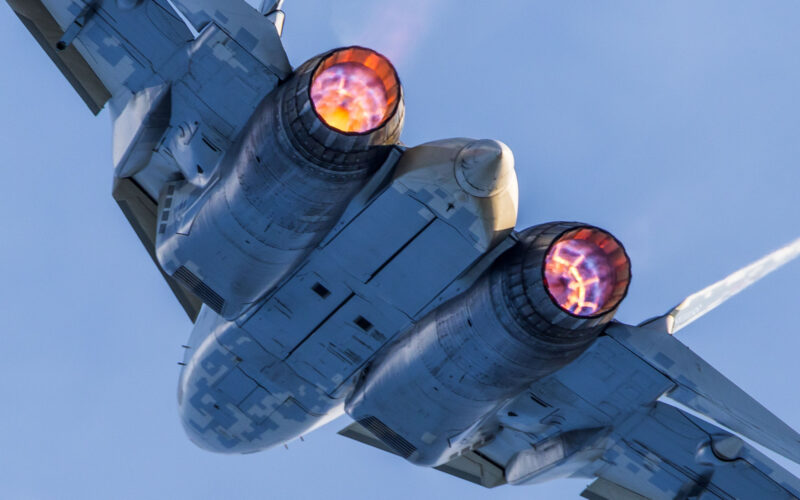
Russia has taken another step in refining its fifth-generation fighter program. In late December 2025, a Sukhoi Su-57 prototype lifted off with a brand-new engine on one side — the long-anticipated Izdeliye-177.
While only a single engine was installed for safety and evaluation purposes, the flight marked the official beginning of airborne testing for a new powerplant intended to strengthen the Su-57’s performance, stealth, and service life.
This development comes as Moscow pushes to accelerate su-57 aircraft production, modernize early aircraft, and make the fighter more attractive on the export market.
First Flight: A New Engine Takes to the Air
On December 22, 2025, a Su-57 prototype successfully completed its maiden flight equipped with one Izdeliye-177 engine, paired with an older engine on the opposite side. This mixed configuration is a standard test approach, allowing engineers to safely evaluate thrust, handling, thermal behavior, and integration without risking the entire aircraft.
The most visually striking feature of the new engine is its serrated exhaust nozzle, immediately signaling a shift toward improved radar and infrared signature reduction — a key requirement for fifth-generation aircraft survivability.
Why the Su-57 Needed an Upgrade
Most operational Su-57s delivered in early production batches still rely on the AL-41F1 (Izdeliye-117) engine. While powerful and proven, it was always intended as a temporary “Stage-1” solution, adapted from the Su-35 rather than designed specifically for a stealth fighter.
Limitations of the AL-41F1:
- Round nozzle with higher radar and IR visibility
- Limited supercruise capability
- Lower fuel efficiency compared to newer designs
- Shorter service life by modern standards
These constraints left the sukhoi su-57 india short of its full fifth-generation potential, especially in sustained supersonic flight and stealth-optimized operations.
Enter Izdeliye-177: Bridging the Gap
The Izdeliye-177 is positioned as a modernized, drop-in upgrade rather than a full clean-sheet design. Developed by United Engine Corporation (UEC), it incorporates newer materials, refined aerodynamics, and updated thermal management while remaining compatible with existing Su-57 airframes — and potentially other Sukhoi fighters.
Key Improvements:
- Afterburner thrust: ~16,000 kgf (156–160 kN)
- Improved dry thrust (exact figures undisclosed)
- Serrated stealth nozzle to reduce RCS and IR signature
- Lower fuel consumption across all flight regimes
- Significantly longer service life, reportedly up to three times that of the AL-41F1
Unlike the interim engine it replaces, Izdeliye-177 is optimized for fifth-generation operational demands, not just raw power.
How It Compares to the True “Stage-2” Engine
Russia has already begun introducing the Izdeliye-30 (AL-51F-1) — the true Stage-2 engine — on the latest su-57 india deliveries from 2023–2024 onward. That engine offers even higher thrust, full supercruise, fewer internal parts, and a better thrust-to-weight ratio.
However, Izdeliye-30 remains more complex, slower to produce at scale, and less suitable as a retrofit for older aircraft. This is where Izdeliye-177 fills a critical niche: offering most of the benefits of modern engine technology while being easier and faster to integrate.
Upgrade Path and Export Potential
The new engine is expected to play a major role in:
- Upgrading early-batch Su-57s already in service
- Enhancing the export-oriented Su-57E
- Serving as a common engine option for other Sukhoi platforms, including potential Su-30 variants
An export version, Izdeliye-177S, is already being marketed to foreign customers, aligning with Russia’s broader effort to expand defense exports amid tightening global competition.
Production Push and What Comes Next
Alongside the engine test announcement, Rostec confirmed that United Aircraft Corporation is expanding production capacity to increase su 57 deliveries to the Russian Air Force and support export commitments. While Moscow has previously announced at least one foreign sales contract for the iaf su-57 kinzhal integration and Su-57E, details remain undisclosed.
If flight testing proceeds smoothly, the Izdeliye-177 could become a practical and scalable solution — strengthening the Su-57 fleet in the near term while the more advanced Izdeliye-30 continues to mature.
Bottom Line
The first flight of the Izdeliye-177 marks more than just another engine test. It represents a realistic path to improving existing Su-57s, closing capability gaps, and making Russia’s stealth fighter more competitive both at home and abroad. While not replacing the ultimate Stage-2 engine, Izdeliye-177 may prove to be the most impactful upgrade the Su-57 sees in the coming years.
For more aerospace news, check out JetlineIntel.
Want to buy aviation merchandise? VisitJetshop.in.
To read Jetlinemarvel’s updates on Google News, head over to Google News.



