
Defence
KF-21 Boramae: South Korea’s Game-Changing Fighter Jet with Global Ambitions
The KF-21 Boramae, developed by Korea Aerospace Industries, is South Korea’s cutting-edge 4.5-gen fighter jet featuring advanced avionics, domestic components, and growing international interest from countries like the Philippines, Indonesia, and Poland.

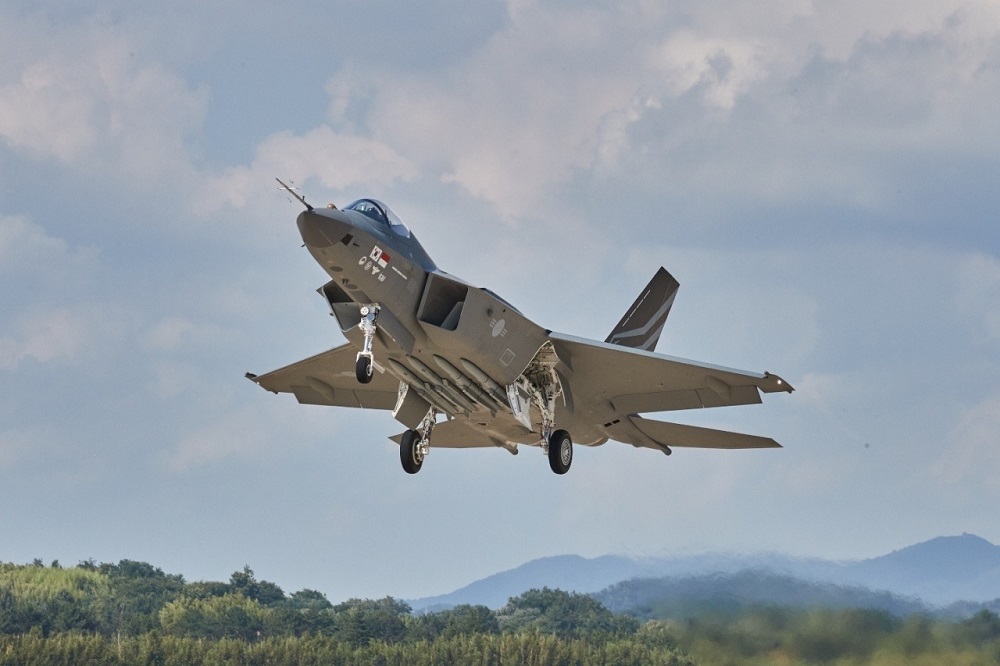
The KF-21 Boramae is one of South Korea’s most ambitious and highly anticipated defense projects, developed by Korea Aerospace Industries (KAI) under the KF-X program launched in 2015.
Initially envisioned as a fifth-generation stealth aircraft, the KF-21 was designed to incorporate low-observable features and stealth-oriented design. However, due to developmental constraints and cost considerations, it currently lacks full stealth capabilities.
As a result, the jet is classified as a 4.5-generation fighter—but still features advanced technologies that place it on par with many of today’s leading multirole combat aircraft.
Development and Production
The program is a joint effort, with South Korea holding a 60% stake and Indonesia originally contributing 20%. In 2024, Indonesia’s share was reduced to 7.5% following financial adjustments, but it still retains access to the program and plans to acquire the aircraft in the future.
The prototype was unveiled in April 2021, followed by its maiden flight in 2022. Mass production began in 2024. As of mid-2025, the Korean government signed a contract with KAI for the production of an additional 20 KF-21 units in a deal worth 2.39 trillion won (approximately $1.75 billion).
This follows an earlier order of 20 aircraft in 2024. Rising production costs have led to a higher per-unit price, now estimated between $70.4 million for the airframe and up to $110 million fully equipped with engines, weapons, and support systems.
Technical Capabilities
Powered by two General Electric F414 engines, the KF-21 produces a combined thrust of around 44,000 pounds. There are plans for future variants to use locally developed engines by Hanwha Aerospace to further enhance South Korea’s defense independence.
The jet has a top speed of Mach 1.8, a combat range of approximately 2,900 kilometers, and a maximum payload capacity of 7,700 kilograms—allowing it to carry both fuel and a wide range of weapons.
It features advanced avionics, including an indigenous Active Electronically Scanned Array (AESA) radar, an Infrared Search and Track (IRST) system, and modern mission computers. The aircraft also includes 9–10 external hardpoints capable of carrying a range of munitions such as Meteor and IRIS-T air-to-air missiles, Taurus KEPD 350 air-to-ground missiles, and a 20mm M61 Vulcan Gatling gun.
Localization and Industry Growth
Approximately 65% of the KF-21’s components are locally produced, including its radar and avionics. This aligns with South Korea’s strategic vision of building a self-reliant defense and aerospace industry, reducing dependency on foreign suppliers, and boosting local innovation.
Global Export Potential
South Korea is actively targeting the Asian and Middle Eastern defense markets for KF-21 exports. Countries that have expressed strong interest include:
- Philippines: Reportedly planning to acquire up to 40 KF-21 jets
- Peru: Showing early interest in the platform
- Poland: Monitoring development closely, particularly the upcoming Block 2 variant
- UAE, Thailand, Malaysia, and Iraq: Identified as potential future buyers
Despite competition from well-established Western jets such as the Dassault Rafale, Saab Gripen, and Lockheed Martin F-35, the KF-21 is positioning itself as a cost-effective alternative—especially attractive to nations seeking modern capabilities at lower procurement and lifecycle costs.
Future Variants and Market Outlook
The current Block 1 version of the KF-21 is primarily focused on air-to-air missions, and lacks full multi-role capabilities. These limitations are expected to be addressed in the Block 2 variant, which is under development and will expand the aircraft’s strike and ground attack roles.
As interest continues to grow, prices may rise depending on configuration options, weapons packages, pilot training, and maintenance infrastructure.
With its blend of affordability, technological sophistication, and export potential, the KF-21 Boramae represents a major step forward for South Korea’s aerospace ambitions and its emergence as a global defense exporter.
What do you think about the KF-21 Boramae fighter jet? Share your thoughts in the comments below.



