
Aviation
India May Build Russia’s Su-57 Stealth Fighters Under ‘Make in India’
Russia has proposed manufacturing its fifth-generation Su-57 stealth fighter in India, a move that could reshape India’s air combat future and strategic alignment.

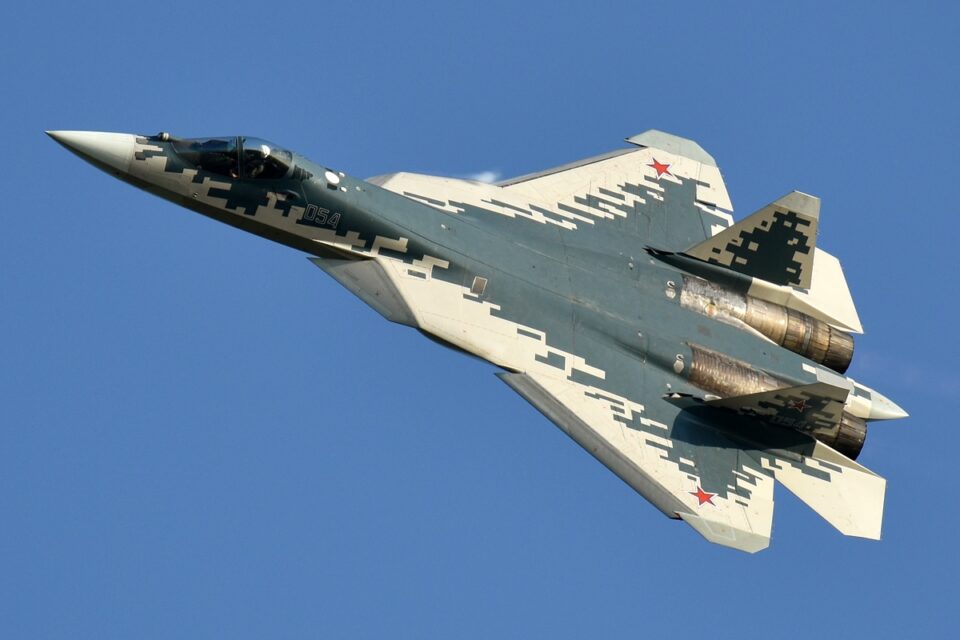
India and Russia share a defense partnership that spans decades, rooted in trust and deep cooperation since India’s independence. For generations, Russia has been New Delhi’s primary source of advanced weapons and missile systems.
One of the most significant symbols of this partnership is the Sukhoi-30MKI fighter jet, which forms the backbone of the Indian Air Force. Not only is it assembled in Nashik by Hindustan Aeronautics Limited (HAL), but many of its components are also produced in India—an arrangement that underscores the reliability of Moscow as a defense partner.
Now, Russia is putting forward a new proposal: to supply India with its most advanced fifth-generation fighter aircraft, the Sukhoi Su-57, and even to explore local manufacturing under the “Make in India” initiative. According to defense sources, Russian agencies are currently studying the scale of investments required to set up Su-57 production facilities in India. HAL, with its experience assembling the Su-30MKI, is being considered as a possible production site.
The Su-57 is Russia’s answer to the American F-35 Lightning II. It combines stealth capabilities with agility, rugged design, and advanced weapon systems. Unlike many Western platforms, Russia has reportedly offered India an unusual level of access, including the possibility of sharing source codes.
This would allow India to integrate its own missile systems, tailor upgrades, and exercise greater operational independence—something rarely seen in international defense agreements.
India’s need for advanced fighters is pressing. The iconic MiG-21 fleet, once the workhorse of the Indian Air Force, is being retired after numerous crashes and nearly six decades of service.
Meanwhile, India’s indigenous Advanced Medium Combat Aircraft (AMCA) program promises a homegrown fifth-generation fighter but faces delays due to technological and engine-related hurdles. The Tejas program is steadily progressing with upgraded variants, but engine dependence continues to slow rapid expansion. In this context, the Su-57 could provide India with a quicker path to fielding cutting-edge fighters while its domestic programs mature.
The timing of Russia’s offer is also significant. India had initially partnered in the Russian fifth-generation fighter program but withdrew nearly a decade ago over cost and technology-sharing concerns.
Today, however, shifting global dynamics may be reopening the door to cooperation. At the same time, India’s relations with the United States have faced strains, with tariffs imposed by Washington and criticism of New Delhi’s Russian oil imports adding friction.
The U.S.-built F-35 remains another strong contender. Over 1,000 Lightning IIs are already in service with the U.S. Air Force, Navy, and Marine Corps, as well as with allies such as the UK, Japan, Israel, Italy, and South Korea.
However, while the F-35 offers unmatched interoperability within NATO, its high acquisition and operating costs make it a less cost-effective option for India compared to the Su-57.
For India, the decision will go far beyond acquiring a fighter jet. It could define the trajectory of its air combat capabilities for decades and shape its broader defense and geopolitical alignment—whether leaning toward Russia’s proven reliability and industrial cooperation, or toward America’s vast ecosystem of defense technology and alliances.
For more aerospace news, check out JetlineIntel.
Want to buy aviation merchandise? Visit Jetshop.in.
To read Jetlinemarvel’s updates on Google News, head over to Google News.
