
Defence
India Converts Legendary Fighter, MiG-21, into High-Speed Target Drone
From ‘Flying Coffin’ to target drone, the MiG-21 embarks on a new role in India’s air defense arsenal.

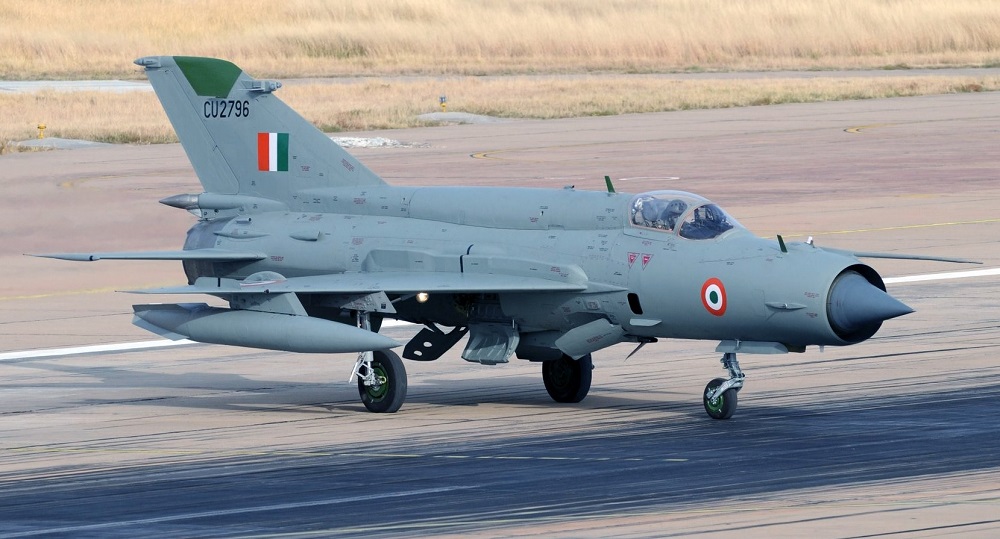
After six decades of service, India’s legendary MiG-21 fighter jet has officially retired on September 26, 2025, marking the end of an era in Indian aviation history.
Known for its speed, agility, and, unfortunately, a notorious safety record, the “Flying Coffin” is now poised for a new role—one that will continue to serve the Indian Air Force, albeit from the skies as a high-speed target drone.
Originally developed by the Soviet Union’s Mikoyan-Gurevich design bureau, the MiG-21 first took to the skies on June 16, 1955, and was later deployed widely as the MiG-21F. Over its long career, more than 11,496 units were produced between 1959 and 1989, with the aircraft being operated by around 60 nations across four continents.
In India, it served with distinction, though its operational history was marred by frequent crashes, earning it the grim nicknames “Flying Coffin” and “Widow Maker.”
With the advent of modern fighters like the Rafale, Tejas, and Su-30MKI, the MiG-21 became outdated, and IAF Chief Air Chief Marshal V.R. Chaudhari emphasized that it was time to move forward with advanced platforms. Yet, retirement does not mean obsolescence—India now plans to convert these venerable jets into target drones to test the next generation of air defense systems.
MiG-21 as a Target Drone: The Future of SAM Testing
Converting retired MiG-21s into target drones offers a cost-effective and practical method for validating the performance of India’s new surface-to-air missile (SAM) systems developed by DRDO:
- Akash-NG: A 50 km-range SAM with an active radar seeker, designed to neutralize low-observable targets and cruise missiles. In 2024 trials, it successfully intercepted a simulated target at 40 km.
- QRSAM (Quick Reaction SAM): A mobile 30 km-range system capable of engaging drones, fighter jets, and missiles even in cluttered battle environments. In 2023, it achieved a direct hit against a Banshee drone.
- XRSAM (Extended Range SAM): Under development with a planned range of 350 km, this missile is intended to counter AWACS, ballistic missiles, and hypersonic threats, with trials expected by 2028.
The MiG-21 Bison, capable of speeds up to Mach 2, high-G maneuvers, and altitudes of 17 km, is ideal for these tests. The conversion process involves stripping non-essential systems, integrating remote-control modules, and adding telemetry systems to collect real-time data—far simpler than converting a fighter into a UCAV (Unmanned Combat Air Vehicle).
Cost-Effective and Efficient
According to sources like idrw.org, converting a MiG-21 into a target drone costs around ₹5-10 crore ($0.6-1.2 million) per aircraft. This is a fraction of the cost of converting it into a full-fledged UCAV (₹50-100 crore) or purchasing new UCAVs like the MQ-9B ($10-20 million). Since each jet is expended in a single test flight, airworthiness maintenance requirements are minimal, making this approach highly economical.
Legacy of the MiG-21
Despite its flaws, the MiG-21 holds a legendary status in aviation history. It was one of the most widely produced and exported fighter jets ever, serving countless air forces around the world. Its role as a high-speed target drone ensures that even in retirement, the “Flying Coffin” will continue to contribute to India’s defense readiness, helping the IAF train against next-generation aerial threats.
As the MiG-21 bows out, India’s air defense capabilities move forward, ushering in an era of advanced fighters and sophisticated missile systems—all while paying homage to a jet that defined generations of pilots.
