
Aircraft comparison
Comparison between the Rafale and F-15 Eagle
The Rafale and F-15 Eagle, two legendary fighters from Dassault Aviation and Boeing, showcase different philosophies in speed, versatility, firepower, and operational support worldwide.

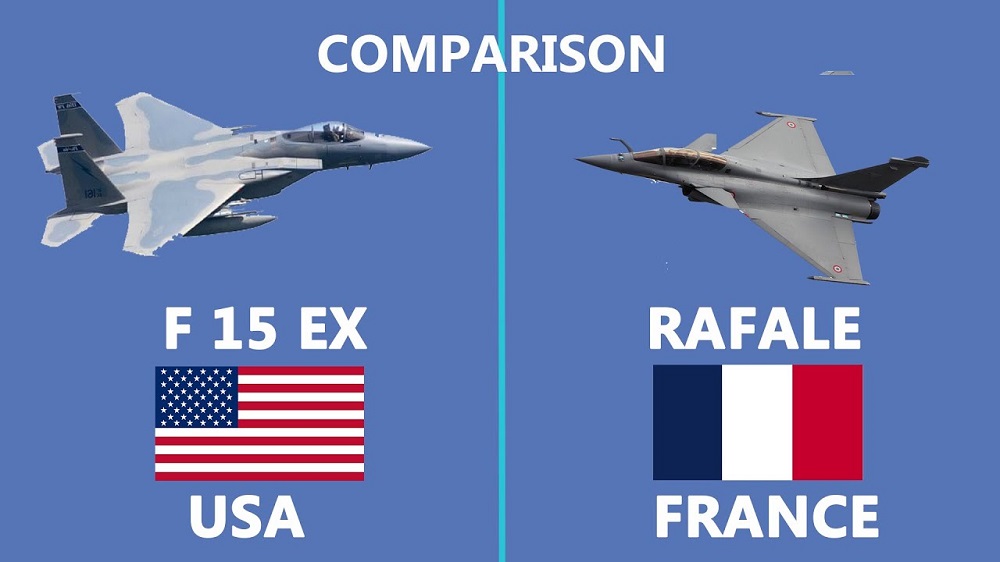
When it comes to modern air combat, two fighters often grab the spotlight: the French Rafale and the American F-15 Eagle. Both are powerful, versatile, and battle-tested, but they were built with slightly different philosophies.
The Rafale is a sleek, multirole jet designed for agility and adaptability, while the F-15 Eagle is a heavyweight air superiority fighter, famous for its speed, range, and firepower.
Comparing these two legends gives us a glimpse into the evolving world of fighter aircraft and what makes each of them unique in the skies.
Length: The F-15 is longer at 63 ft 9 in (19.43 m), whereas the Rafale is shorter at 50 ft 1 in (15.27 m).
Maximum takeoff weight (MTOW): The F-15 can take off at a maximum of 68,000 lb (30,844 kg), while the Rafale has a lower MTOW of 54,013 lb (24,500 kg).
Fuel capacity: The F-15 carries 13,455 lb (6,103 kg) internally, or up to 25,350 lb (11,500 kg) with external tanks. The Rafale carries 4,700 kg (10,362 lb) internally with additional 6,700 kg (14,771 lb) in external tanks.
Engines: The F-15 is powered by 2 Pratt & Whitney F100-PW-220 afterburning turbofans with 23,770 lbf (105.7 kN) thrust each with afterburner. The Rafale uses 2 Snecma M88-4e turbofans producing 75 kN (17,000 lbf) thrust each with afterburner.
Maximum speed: The F-15 can reach Mach 2.5 (1,650 mph / 2,655 km/h) at altitude, while the Rafale reaches Mach 1.8 (1,188 mph / 1,912 km/h).
Range: The F-15 has a combat range of around 586 nmi (674 mi / 1,085 km) on counter-air missions, while the Rafale has a combat range of 1,850 km (1,150 mi / 1,000 nmi) on penetration missions.
Avionics: The F-15 uses AN/APG-63 or APG-70 radars, with advanced AESA versions available, and a variety of electronic warfare systems including ALQ-131 and ALQ-135. The Rafale uses the Thales RBE2-AA AESA radar, SPECTRA EW system, and OSF IRST for infrared search and tracking.
Missiles and weapons: The F-15 carries AIM-7 Sparrow, AIM-9 Sidewinder, and AIM-120 AMRAAM missiles, plus a 20 mm M61A1 Vulcan cannon. The Rafale carries MICA EM/IR, Meteor, Magic II air-to-air missiles, various air-to-surface missiles including Storm Shadow, Apache, AASM-Hammer, Exocet, and a 30 mm GIAT 30 cannon.
Hardpoints: The F-15 has 9 total hardpoints with provisions for missiles, fuel tanks, and pods. The Rafale has 13–14 external hardpoints depending on the version, capable of carrying up to 9,500 kg (20,900 lb) of ordnance and fuel.
The F-15 Eagle is an American air superiority fighter developed by McDonnell Douglas (now Boeing). It made its first flight in July 1972 and was designed primarily for achieving air dominance with unmatched speed, range, and firepower. Over the decades, it has become one of the most successful and widely recognized fighters in the world.
On the other hand, the Rafale is a French multirole fighter developed by Dassault Aviation, with its first flight in July 1986. Unlike the F-15, the Rafale was designed to be a versatile jet capable of performing air-to-air combat, ground attack, reconnaissance, and nuclear strike missions, making it a true “omnirole” fighter.
The F-15EX has a design life of 8,000 hours, although testing over 30,000 hours has shown it to be robust. It is relatively large on radar compared to the F-35 A due to its greatest radar cross-section of 42.8 feet.
Meanwhile Rafale has a design life of 6,000 flight hours, with testing showing it to be highly durable and reliable. It has a relatively small radar cross-section due to its compact design and advanced shaping.
The F-15 has proven itself as a remarkable fighter for decades. While not stealthy, the F-15EX still retains exceptional dogfighting capabilities, allowing it to compete with fifth-generation fighters. Additionally, the F-15EX could potentially replace the E/A-18 Growler, as production of the Growler is set to end in 2027.
Recently, Dassault Aviation and Tata have signed four Production Transfer Agreements to begin manufacturing key fuselage sections of the Rafale fighter jet in India. This partnership represents a major step forward in strengthening India’s aerospace manufacturing sector and further integrating the nation into the global defense and aviation supply chain.
Regions in Illinois, Kansas, Missouri, and Washington are actively supporting production, which has significant congressional support. North Carolina, Oregon, and Georgia all have significant institutions that support F-15 operations. Boeing’s wide influence is evident, with business conducted in all 50 states.
Meanwhile, Rafale is actively operated and supported by several countries, with France being the primary operator.
Other key operators include India, Egypt, Qatar, and Greece, all of which have invested in infrastructure, training, and maintenance facilities to support Rafale operations. Dassault Aviation provides extensive support and partnerships, ensuring the aircraft’s operations, upgrades, and logistics are well-managed across all operator nations.
For more aerospace news, check out JetlineIntel.
Want to buy aviation merchandise? Visit Jetshop.in.
To read Jetlinemarvel’s updates on Google News, head over to Google News.
