
Airport
Rolls-Royce to start UltraFan prototype tests this year

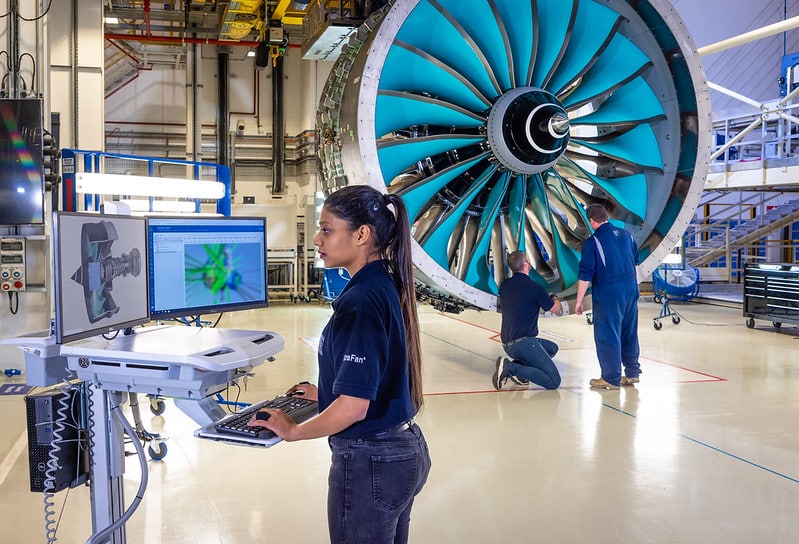
Rolls-Royce has announced the completion of the world’s largest aero-engine technology demonstration, UltraFan®, which will provide a portfolio of technologies to support sustainable air travel for decades to come.
During the Farnborough Airshow, Rolls-Royce announced their new engine Demonstrator Ultra fan, which might be the newest technology generation in aviation, benefiting airlines more in terms of capacity and efficiency.
The 140-inch-fan-diameter demonstrator engine is being finished at the RR plant in Derby, UK, before its inaugural flight later this year on 100 percent Sustainable Aviation Fuel. When compared to the original generation Trent engine, it improves fuel efficiency by 25%.

Courtesy : Rolls Royce
UltraFan provides a wide range of environmental solutions. In the near future, there may be opportunities to adapt innovations from the UltraFan development programme to current Trent engines, resulting in even greater fuel efficiency and emission reductions.
Longer future, UltraFan’s scalable technology from 25,000 to 100,000lb thrust has the ability to power new narrowbody and widebody aircraft in the 2030s.

Courtesy : Rolls-Royce
UltraFan provides a framework for the utilisation of a variety of energy options and power systems, including current jet fuel and sustainable aviation fuels, as well as future hybrid-electric and hydrogen potential.
Key engineering features of the engine include:
- A new, proven, Advance3 core architecture, combined with our ALECSys lean burn combustion system, to deliver maximum fuel burn efficiency and low emissions
- Carbon titanium fan blades and a composite casing
- Advanced ceramic matrix composite (CMC) components that operate more effectively at high pressures and temperatures
- A geared design that delivers efficient power for the high-thrust, high bypass ratio engines of the future. The power gearbox has run at 64MW, an aerospace record
When UltraFan is on test at Rolls-Royce’s new £90m Testbed 80 facility, data can be taken from more than 10,000 parameters, detecting the tiniest of vibrations at a rate of up to 200,000 samples per second.


