Aviation
Air India AI171 Crash: Who Shut Off the Fuel Supply?

Tragedy Strikes: June 12, 2025
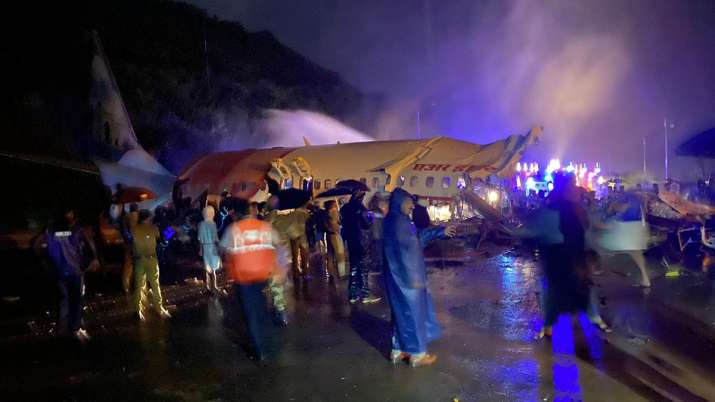
On June 12, 2025, Air India Flight AI171, a Boeing 787 Dreamliner en route from Ahmedabad to London Gateway, crashed just 32 seconds after takeoff, slamming into a medical hostel in the Meghani Nagar neighborhood of Ahmedabad. The devastating crash resulted in the loss of 241 of the 242 people on board, and 19 fatalities on the ground.
The Aircraft Accident Investigation Bureau (AAIB) released its preliminary report on July 8, shedding light on what might have gone wrong during this tragic flight.
Flight and Aircraft Overview
- Aircraft: Boeing 787 Dreamliner
- Age: Approximately 11 years
- Route: Ahmedabad (Runway 23) to London Gateway
- Occupants: 230 passengers and 12 crew
- Fuel on Board: Approx. 54,200 kg
- Takeoff Weight: Around 213,000 kg (within permissible limits)
Shortly after departure, the flight crew issued a Mayday call, reporting loss of engine power and thrust, and an inability to climb. The aircraft impacted a hostel complex, leading to India’s deadliest aviation disaster in recent years.
Preliminary Findings: A Deepening Mystery
Fuel Supply Cut-Off
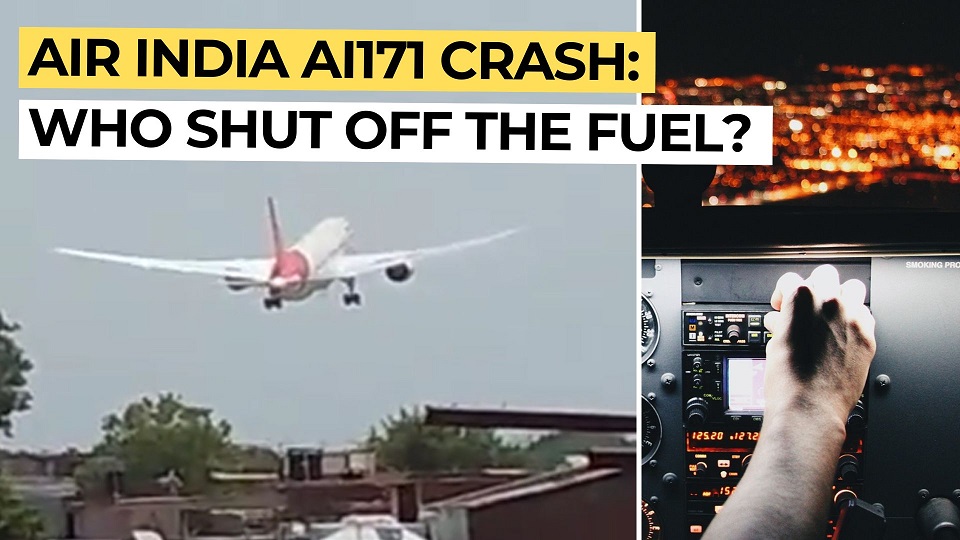
The AAIB’s initial analysis indicates that both engine fuel control switches were manually turned off, just one second apart—then later turned back on. This sequence of actions has become the central focus of the investigation.
The Boeing 787’s fuel switches are protected by a locking mechanism, making it extremely difficult to shut them off accidentally. The manual fuel shutoff raised serious questions, particularly since both pilots were experienced professionals trained not to touch these controls during takeoff.
Voice recordings captured from the cockpit voice recorder (CVR) further intensified the mystery:
Pilot 1: “Why did you shut off the fuel?”
Pilot 2: “I didn’t shut it off.”
This exchange suggests either a critical misunderstanding, accidental activation, or a potential systems anomaly.
Technical Systems: What Else Went Wrong?
Further investigation has ruled out fuel contamination—samples tested clean and met quality standards. There were also no immediate mechanical or design faults found with the Boeing 787 or its GE Aerospace GEnx engines, which are widely regarded as some of the most advanced in commercial aviation.
However, investigators noted:
- Landing gear failed to fully retract, possibly due to hydraulic system failure
- Ram Air Turbine (RAT)—an emergency power generator—was deployed, indicating a catastrophic loss of hydraulic or electrical power
- Flaps and slats were extended at the time of the crash, suggesting the aircraft followed standard takeoff procedures
Black Box Recovery and Data Analysis
Both the Cockpit Voice Recorder (CVR) and Flight Data Recorder (FDR) were recovered and successfully decrypted at the AAIB lab in Delhi by June 25, 2025. A “golden chassis” method was used to ensure full data integrity during extraction.
The analysis is ongoing and focuses on:
- Pilot actions and communications
- Engine behavior
- Fuel control switch operation
- Electrical and hydraulic system performance
Simulation and Safety Reviews
Simulations run by Air India pilots suggest that even with landing gear deployment issues, the aircraft should have been able to remain airborne. This points to more complex system failures, possibly a combination of engine flameout, power loss, and shutdown mechanisms being triggered.
As a result, the investigation is widening its scope to explore:
- Crew psychological condition
- Recent maintenance activities
- Possible software or system malfunction
- Security or sabotage concerns (though none confirmed so far)
The First Hull Loss of a Boeing 787
This tragic incident marks the first total hull loss of a Boeing 787 Dreamliner, a type known for its cutting-edge technology and high safety record. The crash has sent shockwaves through the aviation industry and prompted renewed discussions on flight system safeguards, crew training, and technical audit standards.
Ongoing Investigation: Still No Final Conclusion
As of now, the AAIB emphasizes that the report is preliminary and non-exhaustive. More information will surface in the coming weeks as investigators continue working alongside international aviation experts.
There is still no conclusive evidence pointing to human error, mechanical failure, or external interference. However, the manual shutdown of the fuel supply is a major point of concern—and understanding why and how it occurred will be key to preventing future tragedies.
Final Thoughts and Call to Action
This catastrophic event is not just a blow to Air India—it is a warning sign for the global aviation community. Whether due to a rare technical fault, a human factor, or an unexpected system failure, this crash has triggered intense scrutiny of cockpit protocols, fail-safe systems, and emergency handling procedures.
We’ll continue to follow the developments closely and bring you verified updates as more details emerge.
What do you think caused the mysterious fuel shutoff in Air India’s Boeing 787 cockpit?
Let us know your thoughts in the comments below.
And don’t forget to stay tuned—we’ll be covering upcoming investigation findings in future reports.