
Aviation
Possible Causes Behind the Air India Flight AI-171 Crash

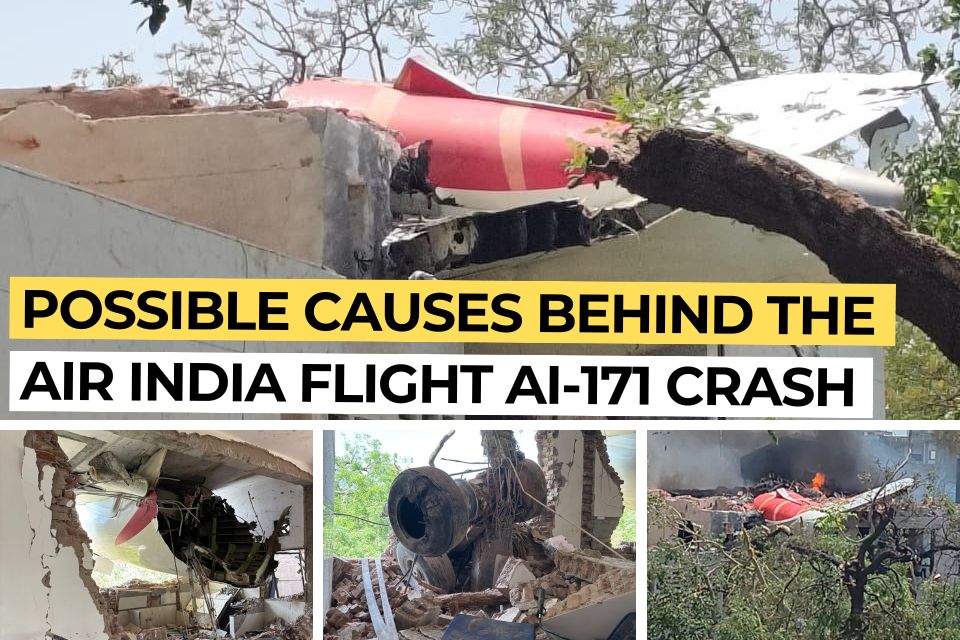
The world is in shock after the tragic crash of Air India Flight AI-171, a Boeing 787 Dreamliner, which went down shortly after takeoff from Sardar Vallabhbhai Patel International Airport in Ahmedabad on June 12, 2025.
The flight was bound for London Gateway and was carrying 242 passengers and 12 crew members. It departed at 1:38 PM IST and crashed just minutes later into the Begani Nagar residential area, near the airport.
The aircraft, registered as VT-ANB, was under the command of Captain Sumit Sabarwal, an experienced pilot with approximately 8,200 flight hours. He was assisted by First Officer Clive Kunder, who had logged around 1,100 flight hours.
According to flight tracking data from FlightRadar24, the aircraft took off from Runway 23 using the full 11,000-foot runway length. It backtracked to the runway’s end before initiating its takeoff roll.
The data shows the aircraft reached an altitude of 625 feet (around 130 meters), with a ground speed of 174 knots and a vertical climb rate of 896 feet per minute.
However, contact with the flight was lost less than a minute after departure. The crew issued a Mayday call to air traffic control, but no further communication was received.
The aircraft crashed into the doctors’ hostel at BJ Medical College, causing extensive damage and triggering a massive fire, fueled by the heavy fuel load for the long-haul flight.
Tragically, there were claims that no survivors among the 242 people on board. Victims included 169 Indian nationals, 53 British nationals, one Canadian, and seven Portuguese citizens. As of now, 100 bodies have been recovered from the crash site.
Investigations Underway
A number of possible causes are being explored. Experts suggest that a technical or engineering fault may be involved, especially since the aircraft had recently undergone maintenance and republishing.
Notably, observations indicated that the aircraft struggled to gain sufficient lift, with the landing gear still down and flaps retracted—possibly pointing to a mechanical issue or in-flight emergency.
The Directorate General of Civil Aviation (DGCA) and the Aircraft Accident Investigation Bureau (AAIB) are leading the investigation, with technical support from Boeing. The recovery of the flight data recorder and cockpit voice recorder is expected to shed more light on the events that led to the crash.
Some analysts have also suggested a bird strike could be a contributing factor, as the aircraft was flying over a residential area where birds are commonly present at low altitudes.
A bird strike, particularly if it affected the engine, could cause serious malfunction. Observers noted the lack of smoke from the engines, which could align with this theory, though it remains unconfirmed.
In addition, prior to this flight, a few passengers had reported technical issues, including malfunctioning in-flight entertainment systems, raising concerns about the thoroughness of the aircraft’s recent maintenance.
Air India’s Response and Fleet Strategy
This incident marks Air India’s first major hull loss since 1985. The airline has been working to modernize its fleet and enhance operational flexibility for international travel. Its long-haul fleet includes Boeing 787s and 777s, forming the backbone of its international network.
Following the crash, Air India has reaffirmed its commitment to strict aviation safety protocols and is cooperating fully with authorities throughout the investigation.
