
Aviation
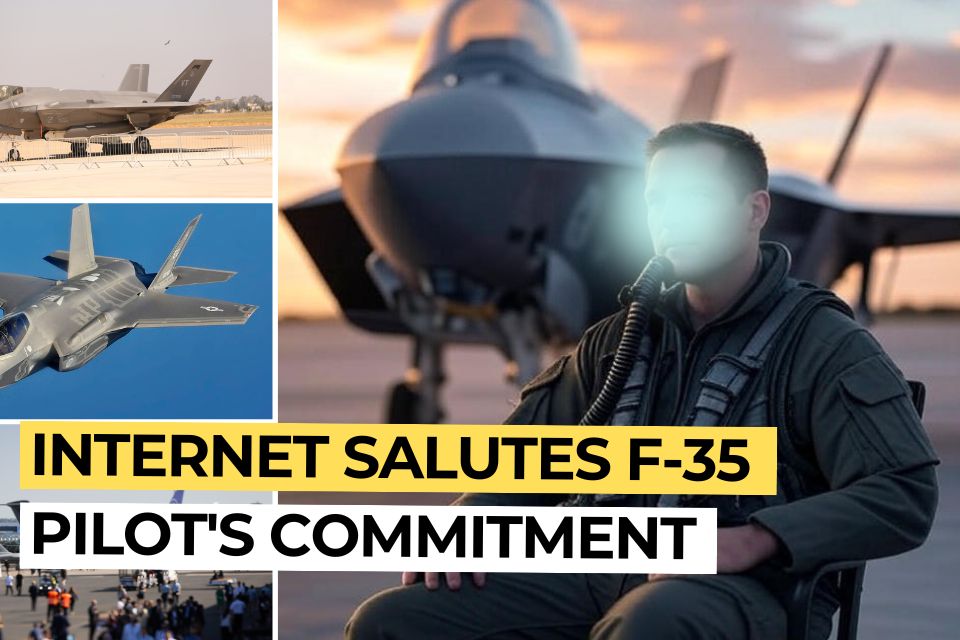
Internet Applauds F-35 Pilot for Staying with Aircraft at Airport

A British Royal Navy F-35B Lightning II fighter jet made an emergency landing at Thiruvananthapuram International Airport on the night of June 14, 2025, around 9:30 p.m. IST.
The aircraft, operating from the HMS Prince of Wales—part of the UK’s Carrier Strike Group 25 deployed in the Indo-Pacific—was forced to divert due to critically low fuel levels and adverse weather conditions.
Incident Overview
The F-35B had been engaged in routine flying operations outside India’s Air Defence Identification Zone (ADIZ) as part of a joint naval exercise with the Indian Navy in the Western Arabian Sea.
As per prior operational planning, Thiruvananthapuram was designated as an emergency recovery airfield between June 9–10, 2025, in case of in-flight contingencies during the exercise.
On June 14, the pilot reported low fuel to air traffic controllers at approximately 9:20 p.m. and issued the QAC-7700 emergency code. Sources indicate that poor weather conditions—likely due to the monsoon—made a safe recovery onto the HMS Prince of Wales, stationed about 100 nautical miles off the Kerala coast, impossible.
Rough seas and limited visibility further contributed to the decision to divert to the nearest suitable land-based airfield.
Pilot’s Unusual Response
After landing, the pilot, identified as Captain Mike, completed all mandatory customs and immigration procedures but chose not to leave the vicinity of the aircraft.
Instead, he remained seated on a chair provided by airport officials, staying close to the jet. This unusual behavior is believed to stem from strict NATO and UK security protocols that prohibit leaving such a technologically sensitive aircraft unattended at a foreign civilian facility.
The F-35B, a fifth-generation stealth fighter built by Lockheed Martin, contains highly classified systems including advanced avionics and stealth technology. The UK, along with NATO allies, enforces stringent measures to ensure its operational security at all times.
Operational and Technical Background
Although fuel reserves on the F-35B were initially sufficient for standard carrier operations, extended flight time due to poor weather or aborted landing attempts may have accelerated fuel consumption.
The F-35 program itself, while representing the pinnacle of modern air combat technology, continues to face scrutiny over its complexity and technical challenges. The jet is available in three variants:
- F-35A (conventional takeoff and landing)
- F-35B (short takeoff/vertical landing – STOVL)
- F-35C (carrier-based operations)
The aircraft involved in this incident, the F-35B, is capable of vertical landings on both sea and land, a feature critical for naval deployments like this.
Current Status (as of June 17, 2025)
More than 48 hours after the emergency landing, the F-35B remains grounded at the airport due to a suspected mechanical issue, possibly involving the hydraulic system. While refueling has been completed, departure is pending both technical rectification and formal clearance from Indian authorities.
The Indian Air Force, along with UK defense officials and local agencies, is closely coordinating the situation.
The jet is under tight round-the-clock security. A Royal Navy helicopter has since arrived to extract the pilot, who has returned to the HMS Prince of Wales, while efforts continue to prepare the aircraft for safe recovery back to the carrier.
This incident highlights not only the complexity of modern military aviation operations but also the strong defense cooperation between India and the United Kingdom in ensuring the safety and security of strategic assets.

