
Aviation
Will Safran Supply engine for Russian built SJ 100 if it manufacture in India
The SJ-100, a 100-seat regional aircraft, is set for Wings India 2026, with HAL-UAC collaboration and potential local manufacturing, challenging Airbus and Embraer in India’s regional market.

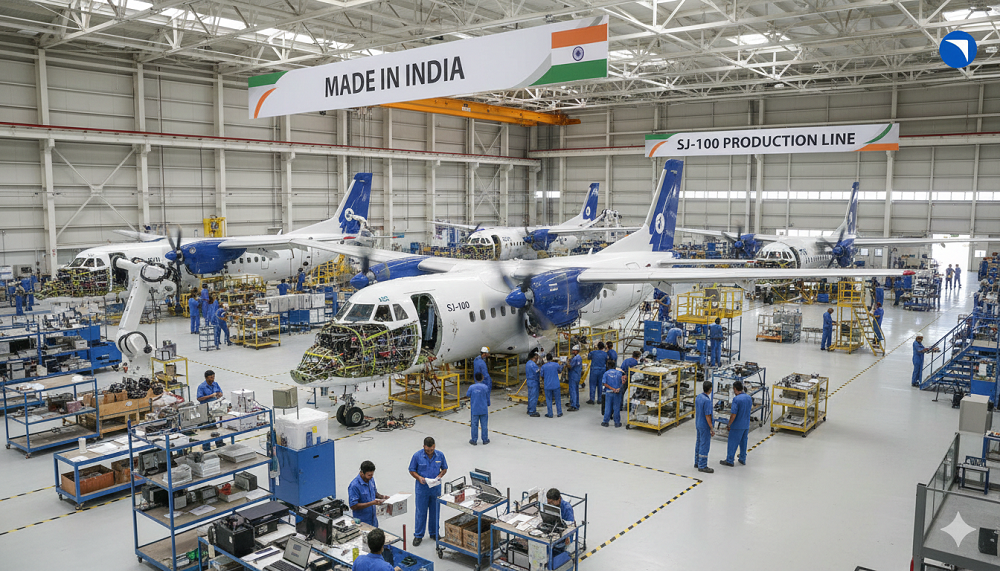
The Yakovlev SJ-100 (formerly Sukhoi Superjet 100, rebranded and import-substituted) standard Russian version uses the fully domestic Russian Aviadvigatel PD-8 turbofan engines (two per aircraft, ~78 kN thrust).
This replaced the original PowerJet SaM146 (a 50/50 Franco-Russian joint venture between Safran Snecma and NPO Saturn) after Western sanctions halted Safran PowerJet support and parts supply to Russia in 2022.
PD-8 development accelerated for “Russification,” with ground flight testing progressing in 2025 (maiden PD-8-powered flights from March 2025 onward), certification targeted around Q1 2026, and serial production ramp-up planned. Russian SJ-100 assembly occurs at Komsomolsk-on-Amur; the PD-8 is standard for Russian operators.
India-HAL plans (MoU signed October 2025 with Russia’s UAC): Hindustan Aeronautics Limited (HAL) signed an MoU in October 2025 for licensed manufacture assembly of the SJ-100 in India (likely at Nashik or Kanpur facilities) exclusively for the Indian domestic market. This would be India’s first modern passenger aircraft production project under “Make in India,” targeting regional routes with potential demand for 200+ units.
Prototypes or early deliveries eyed around 2028–2030. The base design follows the Russian SJ-100, but localization details (including engines) remain under discussion. Engine situation for the Indian variant: The engine choice is undecided and is described as “central” to viability. Russia promotes the PD-8 (higher fuel consumption noted as a drawback for India’s cost-sensitive airlines).
However, Indian sources (late 2025–early 2026 reporting) indicate strong interest in reviving adapting the original SaM146 (proven reliability, ~1.5M flight hours, better fuel efficiency, established global MRO spares network).
India is reportedly in advanced discussions with French authorities and Safran for technology transfer or supply of key SaM146 hot-section/core components (e.g., HP compressor, turbine, combustor, FADEC), with Russia handling the cold section/fan and final assembly/integration possibly localized in India.
This hybrid approach aims to mitigate sanctions risks for Safran while enabling Indian manufacturing MRO hub benefits. No final agreement or Safran commitment has been announced publicly. Safran halted SaM146 support for Russian programs in 2022 but maintains other India partnerships (e.g., Tata-Safran LEAP engine parts facility; recent fighter engine ToT deals), suggesting openness in principle if approvals and commercial terms align.
Sanctions compliance (EU/French/US restrictions on Russia-related programs) would need clearance; supply would likely be structured to support Indian customers only, without re-export risks. Airlines may prefer SaM146 for operational economics and support over PD-8. As of January 2026, production decisions hinge on resolving this propulsion roadmap—no confirmed Safran supply for the Indian SJ-100 yet.
In short, Safran does not supply engines for the current Russian SJ-100 (PD-8 only). For Indian manufacturing, it remains a possibility under ongoing negotiations but is not assured—engine selection is still critical and unresolved.
For more aerospace news, check out JetlineIntel.
Want to buy aviation merchandise? VisitJetshop.in.
To read Jetlinemarvel’s updates on Google News, head over to Google News.
