Aviation
Boeing 777X Folding Wing: Why the 777-9 Has Such a Huge Wingspan

When Boeing launched the 777X, the company wanted to create more than just another long-haul aircraft. The goal was to develop a new-generation widebody that could carry more passengers, fly farther, and deliver better fuel efficiency while building on the success of the Boeing 777 family.
The timing was also significant. Boeing’s iconic 747, which had played a major role in commercial aviation since the late 1960s, was approaching the end of its production era. With the 747 eventually retired from production, Boeing needed a modern aircraft capable of serving the high-capacity long-haul market.
That aircraft became the Boeing 777X, particularly the 777-9.
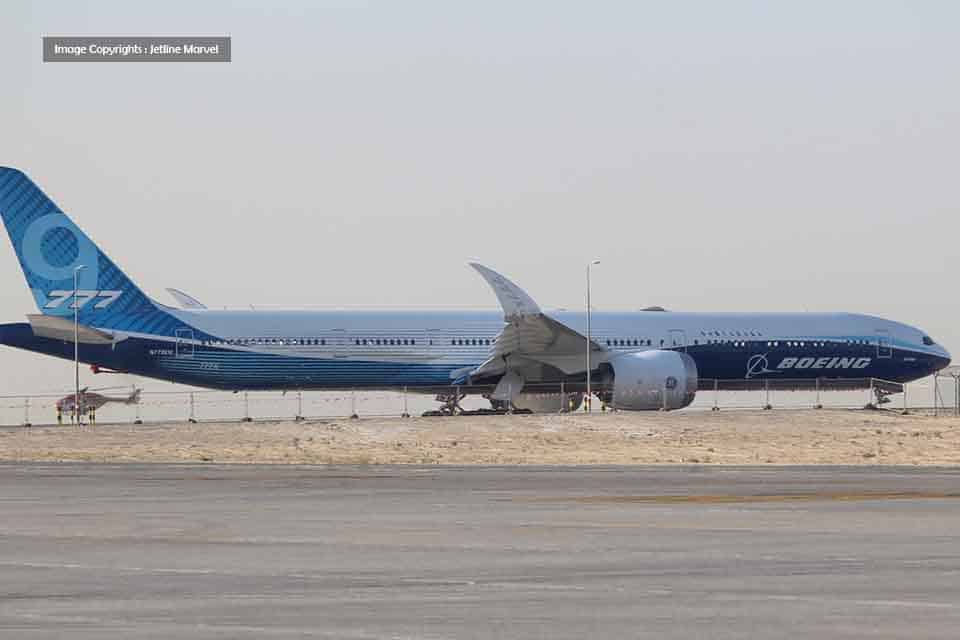
But there is one feature that immediately stands out: its enormous composite wing with folding wingtips.

Why Does the Boeing 777X Have Such a Large Wing?
The Boeing 777-9 has an exceptionally large wingspan. With the wingtips extended, the aircraft’s span is around 235 feet 5 inches (71.8 metres).
That is significantly wider than the fixed wings of many other large twin-engine widebody aircraft, including the Airbus A350-1000, whose wingspan is about 212 feet (64.75 metres).
So why did Boeing build such a massive wing?
The answer is aerodynamic efficiency.
A larger, high-aspect-ratio wing can generate the required lift more efficiently and reduce induced drag, particularly during cruise. Lower drag means the engines do not have to work as hard to maintain the aircraft’s speed and altitude.
For an aircraft designed to fly long-haul routes carrying hundreds of passengers, even a relatively small improvement in aerodynamic efficiency can translate into significant fuel savings over thousands of flights.

The Boeing 777-9 Is a Very Large Aircraft
The 777-9 was designed around a larger capacity and a longer fuselage than the previous-generation 777.
The aircraft is approximately 251 feet 9 inches (76.7 metres) long, making it one of the longest commercial passenger aircraft ever developed.
Depending on the airline’s configuration, Boeing has cited a typical two-class capacity of around 426 passengers.
Its maximum takeoff weight is approximately 351.5 tonnes.
This size allows the 777-9 to target the high-capacity long-haul market while using only two engines.
That is important because Boeing is essentially trying to combine the capacity traditionally associated with very large aircraft with the operating economics of a modern twin-engine jet.
Boeing 777X vs Airbus A350-1000
The Airbus A350-1000 is one of the Boeing 777X‘s most important competitors.
The A350-1000 is approximately 242 feet long, with a wingspan of around 212 feet and a maximum takeoff weight of roughly 319 tonnes, depending on configuration and variant.
The two aircraft take slightly different approaches to efficiency.
The A350 was designed from the beginning as a clean-sheet aircraft with extensive use of carbon-fibre-reinforced polymer composites.

The 777X, meanwhile, builds on the proven 777 architecture but introduces a new composite wing, improved engines, updated systems and a redesigned cabin.
The 777X is also wider internally. Its fuselage allows airlines to operate 10-abreast economy seating, while the A350 is more commonly configured with nine-abreast economy seating.
That extra width can provide airlines with greater passenger capacity, but it also means the aircraft needs substantial lift.
And this is where the huge 777X wing becomes extremely important.
The High-Aspect-Ratio Wing Is the Key
One of the biggest engineering advantages of the 777X is its high-aspect-ratio composite wing.
The longer and thinner wing helps improve the aircraft’s lift-to-drag ratio.
In simple terms, the wing can produce the required lift while creating less aerodynamic drag.
This becomes particularly valuable during cruise, when the aircraft spends most of its long-haul flight.
The wing also has a very high degree of flexibility. During flight, the enormous composite structure can flex upward significantly under aerodynamic loading.
That flexibility is not a weakness.
It is an intentional part of the design.
The composite wing provides the strength required for the aircraft while allowing Boeing to build a long, relatively thin and aerodynamically efficient structure without the weight penalty that would come with a comparable conventional metal wing.

Why Is the Boeing 777X Wing Made From Composite Materials?
Boeing uses advanced carbon-fibre composite materials for the 777X wing.
Composite structures can provide an excellent combination of high strength, low weight and fatigue resistance.
This allowed Boeing to design a much longer wing than would have been practical with a traditional aluminum structure of comparable weight.
The result is a wing that can provide significant aerodynamic benefits while remaining structurally capable of handling the enormous loads generated by an aircraft of this size.
This is one of the reasons the 777X represents a major evolution of the original 777 design.
But There Was One Major Problem: Airport Size
There was a major problem with making the 777X wing this large.
If Boeing simply gave the aircraft a fixed 72-metre-class wingspan, it would move into the ICAO Code F airport category.
That is the same broad aircraft wingspan category used by aircraft such as the Airbus A380.
And that could create serious problems for airlines.
A larger wingspan can restrict access to certain airport gates, taxiways and parking positions. Airlines could potentially face higher infrastructure costs and fewer airports capable of handling the aircraft efficiently.
Boeing therefore needed a way to get the aerodynamic benefits of a huge wing without turning the aircraft into an airport-infrastructure nightmare.
The solution was one of the most unusual features ever introduced on a commercial airliner.
The Boeing 777X Folding Wingtip
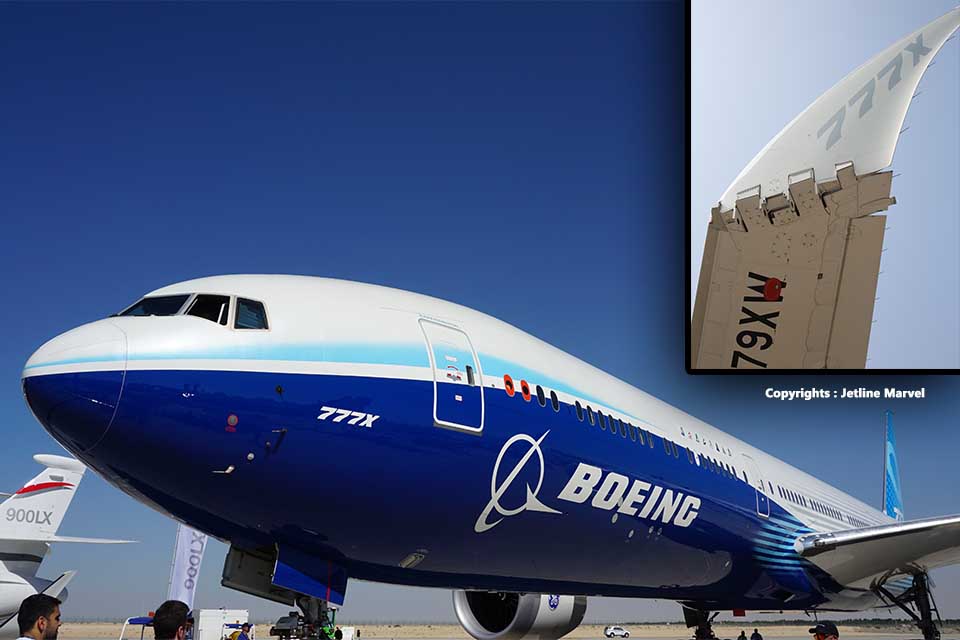
The 777X uses folding wingtips.
During flight, the wingtips remain fully extended, giving the aircraft its enormous aerodynamic wingspan.
But when the aircraft lands and prepares to taxi, the outer sections of the wings fold upward.
This reduces the aircraft’s ground footprint and allows the 777X to remain within the airport compatibility requirements associated with the existing 777.
That means airlines can potentially operate the aircraft through airports and gates designed to handle the previous-generation 777 without needing the same level of infrastructure required for a much larger Code F aircraft.
Folding Wings Are Not New
The idea of folding wings may sound unusual for a commercial aircraft, but the concept itself is not new.
Folding wings have been widely used on naval aircraft.
Fighter aircraft operating from aircraft carriers use folding wings to reduce their footprint while parked on the limited deck space of a carrier.
The Boeing 777X applies a similar basic concept to a completely different problem.
Instead of trying to fit inside an aircraft carrier, the 777X needs to fit within the existing airport infrastructure.
The engineering challenge, however, is much more demanding because this is a large commercial aircraft carrying hundreds of passengers rather than a fighter jet.
GE9X Engines Add Another Major Advantage
The large wing is only one part of the 777X efficiency equation.
Boeing also paired the aircraft with the GE9X, one of the largest and most advanced commercial aircraft engines ever developed.
The GE9X was designed specifically for the 777X family and incorporates technologies intended to improve fuel efficiency, reduce emissions and lower operating costs compared with earlier-generation 777 engines.
Together, the composite wing, aerodynamic improvements and GE9X engines are designed to deliver a substantial improvement in fuel efficiency compared with the previous-generation 777 aircraft.
Boeing has highlighted fuel-efficiency improvements of roughly 10% or more, depending on the comparison and operating conditions.

Why Didn’t Boeing Simply Make a Smaller Wing?
This is where the 777X engineering philosophy becomes interesting.
Boeing could have built a smaller fixed wing and avoided the complexity of a folding mechanism.
But that would have sacrificed some of the aerodynamic advantages of a very long, high-aspect-ratio wing.
Instead, Boeing chose a more complicated solution:
Build a very large wing for flight, then make it smaller on the ground.
That required additional engineering, structural reinforcement and a sophisticated folding-wingtip mechanism.
It also added complexity to an aircraft that was already pushing the limits of commercial-airliner design.
But Boeing accepted that complexity because the potential aerodynamic and operational benefits were considered worthwhile.
Boeing 777X: A Different Approach to Efficiency
The 777X and A350-1000 demonstrate two different approaches to building a modern long-haul widebody.
The Airbus A350 uses a clean-sheet composite design focused heavily on weight reduction and aerodynamic efficiency.
The Boeing 777X takes the proven 777 platform and combines it with a new composite wing, folding wingtips, advanced systems and the GE9X engine.
Neither approach is simply about making the aircraft bigger.
The goal is to find the right balance between capacity, range, fuel efficiency, airport compatibility and operating economics.

Why the 777X Folding Wing Is So Important
The folding wingtip may look like a strange engineering feature, but it solves a very practical problem.
Boeing wanted the 777X to have the aerodynamic benefits of an extremely large wing while avoiding the airport limitations associated with an aircraft of that wingspan.
So the aircraft effectively has two different configurations:
In the air:
A huge, efficient high-aspect-ratio wing.
On the ground:
A narrower aircraft capable of using infrastructure designed around the 777 family.
That is what makes the 777X particularly interesting from an engineering perspective.
The Boeing 777X Could Define the Next Generation of Large Twinjets
The Boeing 777X is not simply a larger 777.
It represents Boeing’s attempt to push the traditional widebody twin-engine formula much further.
With its massive composite wings, folding wingtips, GE9X engines, long fuselage and high passenger capacity, the aircraft is designed to deliver the economics of a modern twinjet while approaching the capacity traditionally associated with much larger aircraft.
The folding wing is therefore not just a gimmick.
It is one of the most important engineering solutions on the entire aircraft.
Boeing essentially accepted greater mechanical and structural complexity to gain aerodynamic efficiency without sacrificing airport compatibility.
And that is what makes the Boeing 777X and 777-9 one of the most technically interesting commercial aircraft programs of the modern era.