
Aviation
The Russian Su-57 gets its first customer from this Country

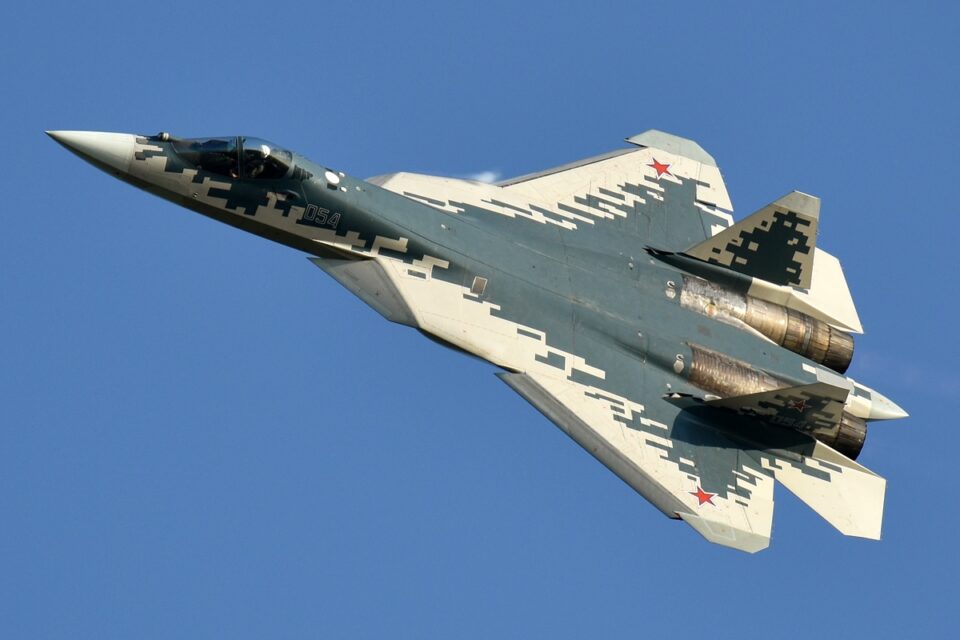
The Russian-made Sukhoi Su-57, a fifth-generation multi-role stealth fighter, is attracting growing international interest following its impressive performances at airshows worldwide.
Developed under Russia’s PAK FA program launched in 1999 to rival American fighters like the F-22 Raptor and F-35 Lightning II, the Su-57 measures approximately 20.4 meters in length with a wingspan of 14.1 meters. It boasts a top speed of Mach 2 and an operational range of around 3,500 kilometers.
Equipped with advanced avionics, including an active electronically scanned array (AESA) radar and an infrared search and track (IRST) system, the Su-57 carries up to 12 air-to-air and air-to-ground weapons internally, preserving its stealth profile.
Its arsenal includes precision-guided munitions such as the Kh-69 stealth cruise missile, the Grom glide bomb, and the R-77EM long-range air-to-air missile. Russian claims emphasize the use of radar-absorbent materials to enhance stealth, though critics note exposed engine nozzles and certain airframe features may increase radar detectability compared to Western fifth-generation jets.
Potential Entry into the Export Market
At the MIL-EX 2025 arms exhibition in Minsk, Belarus, Russia’s Federal Service for Military-Technical Cooperation announced a significant milestone for the Su-57 program, signaling its imminent entry into the global arms market.
While Russia has not officially disclosed the identity of its first foreign Su-57 buyer, speculation strongly points to Algeria. This announcement, covered by the Russian state news agency TASS on May 22, 2025, underscores Russia’s intent to challenge Western dominance in the fifth-generation fighter market, particularly against American platforms like the F-35 and F-22.
Algeria: A Key Partner and Potential First Foreign Operator
Indications of Algeria’s role emerged as early as 2024, when Russian officials confirmed signing an export contract for the Su-57 without naming the customer. Algeria has a longstanding history of acquiring Russian military equipment, including Su-30 fighter jets, S-300 air defense systems, T-90 tanks, and F-100J missile systems.
The training of Algerian pilots on Su-57-compatible platforms suggests a deliberate move to integrate the aircraft into its air force, potentially replacing its aging Soviet-era fleet.
Algeria’s strategic interest in the Su-57 stems from its position as a major military power in North Africa, where it faces ongoing security challenges such as border tensions with Morocco and emerging regional air threats. The Su-57 acquisition could thus enhance Algeria’s deterrence capability and reshape regional power dynamics.
Comparing Algeria’s Su-57 to Morocco’s Western-Supplied Arsenal
Morocco’s current arsenal, heavily supported by French military hardware, provides it with modern capabilities. However, Algeria’s Su-57 acquisition could shift the balance. While the Su-57 features advanced radar systems and long-range weaponry, it lags behind Western fighters like the F-35 in data integration, stealth optimization, and internal weapons capacity. The Su-57’s radar cross-section is also larger, making it more detectable on radar.
Financially, the Su-57 is estimated to cost between $40 and $50 million per unit, compared to approximately $150 million for the F-35. Yet, political and export restrictions limit access to the F-35, whereas Algeria benefits from unrestricted Russian support. Moreover, the Su-57’s compatibility with Algeria’s existing Russian-origin military systems simplifies logistics, training, and maintenance, aligning well with Algeria’s traditional defense partnerships dating back to the Soviet era.
While the F-35 offers superior stealth and interoperability with Western allies, Algeria’s decision to pursue the Su-57 reflects a strategic continuity favoring Russian technology and influence in the region.
For more aerospace news, check out JetlineIntel.
Want to buy aviation merchandise? Visit Jetshop.in.
To read Jetlinemarvel’s updates on Google News, head over to Google News.
