
Aviation
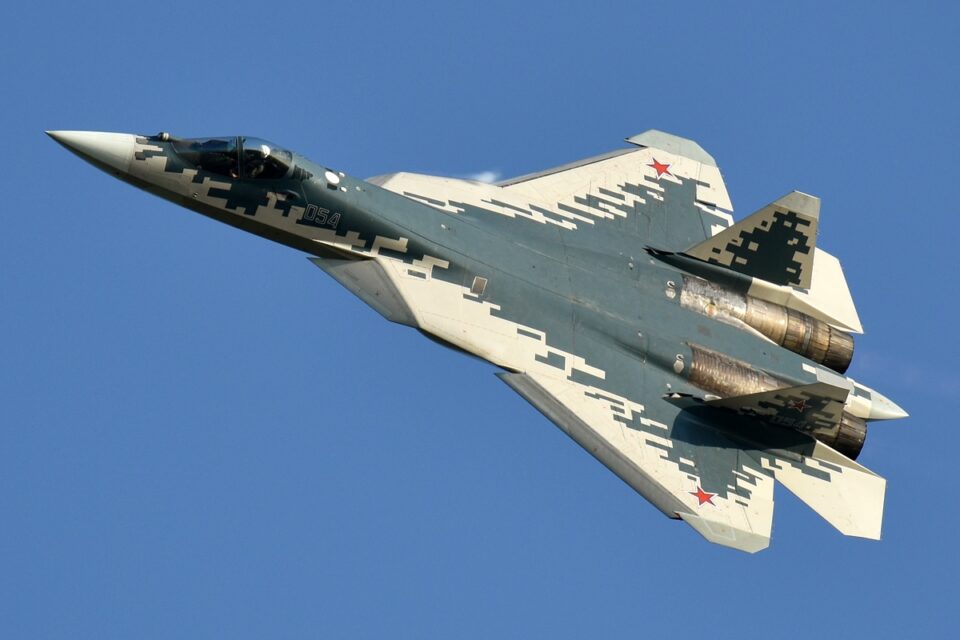
India Eyes 3 Squadrons of Su-57 Stealth Fighters Armed with Kinzhal Missiles
IAF eyes 63 Su-57 jets as Russia offers Kinzhal missile integration, boosting India’s deep-strike power and filling squadron gaps.

When the MiG-21 took its final bow on September 26, 2025, it wasn’t just the end of a fighter jet—it was the end of an era. The Indian Air Force (IAF), already battling a squadron shortfall, suddenly found itself staring at an even wider gap in its combat strength.
With China building up airpower on the LAC and Pakistan expanding its fleet with J-10Cs, India urgently needs a stopgap solution until indigenous fighters like the Tejas Mk2 and AMCA are ready.
Into this vacuum steps Russia with a dramatic proposal: the Su-57 fifth-generation stealth fighter, armed with none other than the hypersonic Kh-47M2 Kinzhal missile.
A Seismic Shift in IAF’s Fighter Strategy
According to a detailed report by India Today, the IAF is considering the acquisition of around 63 Su-57 jets—equivalent to three squadrons—as part of its plan to restore combat strength closer to the sanctioned 42 squadrons. With only 29 squadrons operational today, this deal could serve as a much-needed bridge until the Advanced Medium Combat Aircraft (AMCA) enters service around 2035.
The urgency has been amplified by Operation Sindoor, where the IAF’s multirole capabilities were put to the test against Pakistani defenses. Russia’s Su-57 proposal comes at the right moment, promising both cutting-edge technology and quick deliveries.
Russia’s Offer: Su-57s with a Hypersonic Edge
Moscow is not just offering fighters—it is dangling a crown jewel: the integration of air-launched ballistic missiles (ALBMs), most notably the Kh-47M2 Kinzhal.
- Kinzhal Hypersonic Missile: Mach 10 speed, 2,000 km range, unpredictable ballistic trajectory.
- Strategic Impact: Can evade even top-tier defenses like China’s S-400 or Pakistan’s HQ-9.
- Operational Advantage: Allows India to strike terror camps, C2 nodes, or deep targets from within its own airspace—minimizing risk to pilots.
For the IAF, this would be a game-changing leap in deep-strike capability, echoing the success of the 2019 Balakot airstrikes but with hypersonic certainty.
Features of the Su-57 Fighter
Often called Russia’s answer to the US F-35, the Su-57 is designed to combine stealth, agility, and heavy firepower:
- Stealth Design: Radar-absorbing materials and internal weapon bays reduce radar cross-section.
- Supermaneuverability: 3D thrust-vectoring engines for unmatched agility.
- Supercruise: Sustained supersonic flight without afterburners.
- Payload Capacity: Up to 10 tons of weapons, including hypersonics.
- Advanced Avionics: AESA radar, electronic warfare suite, and AI-assisted systems.
- Manned-Unmanned Teaming: Compatible with Russia’s S-70 Okhotnik-B stealth drone for networked warfare.
Built for rugged operations, the Su-57 is particularly suited for Himalayan conditions and two-front warfare scenarios.
Production Plan: From Moscow to Nashik
Russia’s proposal also mirrors the Su-30MKI success story. The plan includes:
- Initial Delivery: 36–40 jets imported by 2028, enough for two squadrons.
- Local Production: Remaining jets built at HAL Nashik, leveraging existing Su-30MKI assembly lines.
- Indigenization: 40–70% local content targeted, with technology transfer (ToT).
- Cost Estimate: $80–100 million per unit, totaling $5–6 billion for three squadrons.
Crucially, Russia is offering source code access and full ToT—something Western suppliers like the US and France have consistently resisted. This would allow India to integrate its own missiles, customize upgrades, and maintain long-term independence.
Strategic Realpolitik
Analysts note that while Western options like the F-35 remain politically tricky and limited in ToT, Russia is flexible and eager to deepen defense ties—especially amid sanctions after Ukraine. For India, this deal represents pragmatism over prestige: a chance to plug squadron gaps quickly, maintain deterrence on both fronts, and buy time for the AMCA to mature.
If expanded beyond three squadrons, the deal could eventually scale up to seven squadrons—over 120 aircraft—making it one of the largest international procurements of the Su-57, second only to Russia itself.
The Road Ahead
For India, the choice boils down to urgency, sovereignty, and survivability. The Su-57, paired with the Kinzhal missile, offers a fast-track leap into fifth-generation warfare. It revives an old partnership, leverages proven industrial cooperation, and arms the IAF with a capability neither China nor Pakistan can match today.
The MiG-21 era may have ended, but if the Su-57 deal materializes, India could well be writing the opening chapter of its hypersonic stealth era.
For more aerospace news, check out JetlineIntel.
Want to buy aviation merchandise? Visit Jetshop.in.
To read Jetlinemarvel’s updates on Google News, head over to Google News.
