
Aviation
10 Best Aircraft Carriers in the World

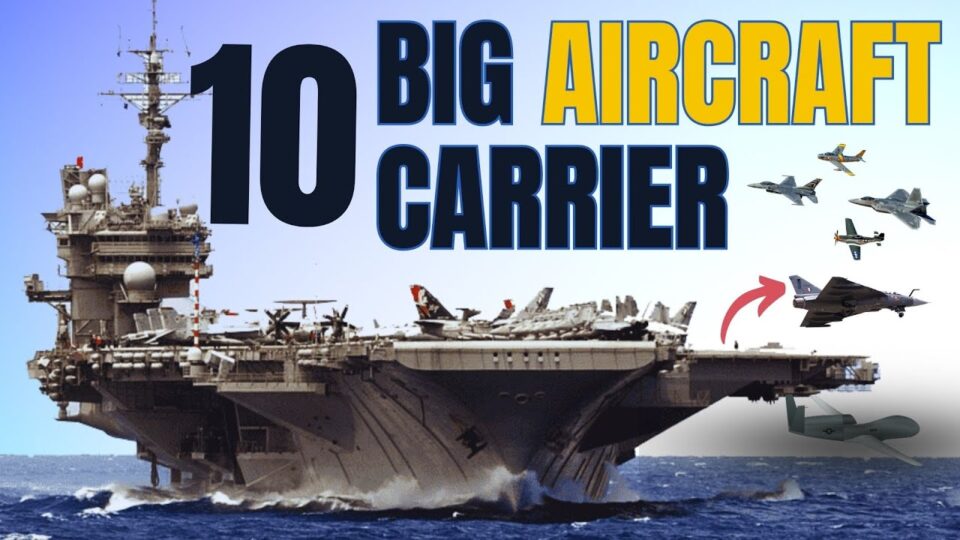
Aircraft carriers epitomize naval power projection, embodying a nation’s capacity to influence vast oceanic expanses.
These floating airbases are central to modern naval warfare, equipped to deploy and sustain an impressive array of aircraft, missiles, and support systems. Beyond their combat roles, they are crucial in humanitarian aid missions and force projection during conflicts, making them pivotal in global geopolitics.
This article explores the 10 best aircraft carriers currently navigating the world’s oceans, representing maritime engineering and strategic prowess. These carriers, hailing from various nations, showcase cutting-edge technologies and operational excellence. Whether through their sheer size, advanced capabilities, or strategic importance, each carrier on this list plays a critical role in redefining the dynamics of contemporary naval warfare and international security.
10 best aircraft carriers
- 1. Gerald R. Ford-class aircraft carrier, US:
The United States Navy is in the process of constructing the Gerald R. Ford-class nuclear-powered aircraft carriers, designed to bolster its naval capabilities. These carriers boast a remarkable capacity, capable of accommodating over 75 aircraft and a crew of up to 4,539 personnel. Fueled by two nuclear reactors, these vessels provide unmatched endurance and operational range. Scheduled for commissioning in 2025, the second ship of the class, John F. Kennedy (CVN-79), embodies cutting-edge technology and formidable capabilities.
With a total load displacement of 100,000 tons, these carriers represent a formidable presence on the seas. Their flight decks, stretching an impressive 78 meters, are outfitted with state-of-the-art equipment, including an electromagnetic aircraft launch system and advanced gear, ensuring swift and efficient operations. However, such prowess comes with a hefty price tag, with each unit costing approximately US$12.998 billion.
2. Nimitz– class aircraft carrier USA:
It is ten nuclear-powered aircraft carriers currently serving in the United States Navy. Each ship measures an impressive 1,092 feet (333 meters) in overall length and has a full-load displacement exceeding 100,000 long tons (100,000 metric tons). Until the USS Gerald R. Ford joined the fleet in 2017, Nimitz-class carriers held the distinction of being the largest warships ever constructed and operational. As of 2023, the cost of a Nimitz-class carrier is estimated at $11.2 billion.
3. Fujian aircraft carrier, China:
Named after China’s Fujian province, the third vessel in the Chinese aircraft carrier program is the Fujian. Launched on June 17, 2022, it is currently undergoing sea trials as of May 2024. With a full-load displacement of approximately 80,000 tonnes, the Fujian stretches 316 meters in length and boasts a beam of 76 meters. Notably, it is outfitted with an electromagnetic catapult, marking a significant advancement as the first Chinese aircraft carrier to support catapult-assisted take-offs from its deck.
4.Admiral Kuznetsov, Russia:
Initially named Riga, this aircraft carrier serves as the flagship of the Russian Navy. It boasts impressive dimensions, with a length of 305 meters and a beam of 72 meters, resulting in a full load displacement of 58,500 tons. Spanning an expansive 14,700 square meters, it has the capacity to accommodate up to 33 fixed-wing aircraft and 12 helicopters. However, as of 2020, the project had not received approval, primarily due to its substantial financial implications, estimated at $9 billion. This raised concerns about potential impacts on other modernization efforts within the Russian naval fleet.
5.INS Vikrant, India:
INS Vikrant, currently serving in the Indian Navy, marks India’s fourth aircraft carrier and a significant milestone as the nation’s first carrier built domestically. Its construction, amounting to US$3.2 billion in 2023, underscores India’s growing indigenous naval capabilities. With a loaded displacement of approximately 45,000 tons, INS Vikrant stretches 262 meters in length and 59 meters in width (beam). Although INS Vikramaditya surpasses it in size, INS Vikrant distinguishes itself with its utilization of more advanced technology.
6.Charles De Gaulle, France:
It stands as the flagship of the French Navy, marking a significant milestone as the first French nuclear-powered surface vessel and the sole nuclear-powered carrier completed outside of the United States Navy. Constructed at cost of €3 billion in 2001, this carrier boasts a displacement of 42,500 tonnes and stretches 261.5 meters in length. Its impressive capacity allows it to accommodate up to 40 fixed-wing aircraft and helicopters. Designed with a focus on versatility and stealth, Charles de Gaulle excels in both assault and transport roles, exemplifying France’s commitment to global security and showcasing its formidable naval power.
7.Cavour, Italy:
Launched in 2004, Cavour stands as Italy’s aircraft carrier, boasting a full-load displacement of 30,000 tons. Equipped with various defense systems, including short-range defense systems, guns, and decoy launchers, it ensures comprehensive security. The carrier, with a price tag of €1.39 billion in 2010, features a spacious 232.6-meter-long flight deck capable of accommodating up to 20 aircraft. Moreover, Cavour houses a sizable hangar area, providing storage for up to 24 main battle tanks, further enhancing its versatility and strategic value.
8.Juan Carlos I, Spain:
This multi-purpose aircraft carrier-landing helicopter dock unit, with a unit cost of €462 million, was launched in September 2009 and commissioned in September 2010. Measuring 230.8 meters in length and boasting a beam of 32 meters, it offers substantial space and capability. With a complement of approximately 900 naval personnel, along with equipment and support elements for 1,200 soldiers, it stands as a formidable asset. The carrier features a 202-meter flight deck complete with a ski-jump ramp, facilitating operations with AV-8B Harrier II aircraft.
9.Queen Elizabeth-class aircraft carrier, UK:
The Queen Elizabeth-class, comprising two vessels constructed by the Aircraft Carrier Alliance, represents a monumental investment, with a unit cost of £7.6 billion as of 2019. These carriers, boasting a displacement of around 65,000 tonnes and stretching 280 meters in length, stand as formidable symbols of naval power.
Despite their size and capability, these carriers operate efficiently with a relatively small crew of 679 personnel for combat operations. Their versatility is showcased by their ability to embark on up to 40 rotary and fixed-wing aircraft, including 36 F-35B jets and four Merlin helicopters, underscoring their pivotal role in modern naval warfare.
10.HTMS Chakri Naruebet, Thailand:
As the flagship of the Royal Thai Navy, Chakri Naruebet stands as Thailand’s first and only aircraft carrier, built at cost of US$285 million. The vessel measures 182.65 meters in length and has a beam of 30.5 meters. It can accommodate up to 675 troops and features a flight deck that spans 174.6 meters in length.
Chakri Naruebet has played a crucial role in various disaster relief operations, notably in the aftermath of the 2004 Indian Ocean earthquake and tsunami, demonstrating its versatility and humanitarian capability.
