
Defence
KAI Developing Advanced AI Pilot for FA-50 to Compete with JF-17 & Tejas

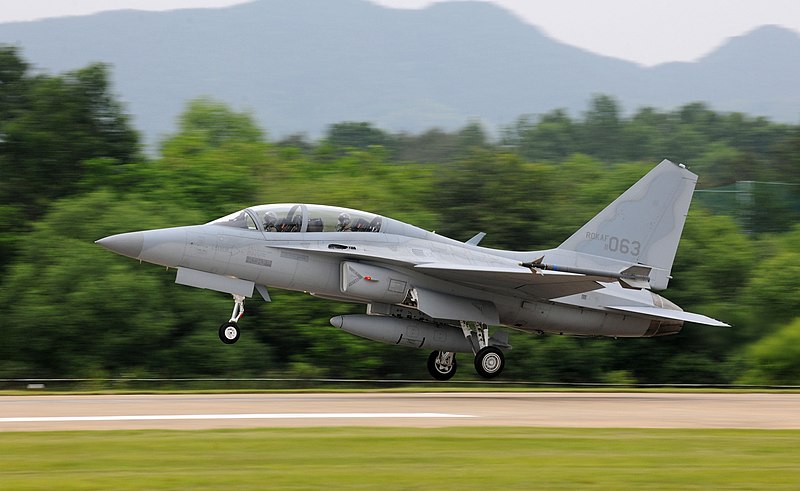
Korea Aerospace Industries (KAI) is taking a bold step toward the future of aviation by developing an artificial intelligence (AI) pilot system that will eventually fly the FA-50 light combat aircraft.
The FA-50 is a single-engine, supersonic aircraft developed by Korea Aerospace Industries (KAI) and based on the T-50 Golden Eagle trainer, created for the Republic of Korea Air Force (RoKAF) with technical support from Lockheed Martin. It was designed to meet the growing global demand for affordable lead-in fighter trainers and light-attack aircraft.
Targeting the expanding market in the Asian region, the FA-50 is being developed with advanced features, including AI integration. Similar to how the F-16 fighter jet was equipped with AI to autonomously control the aircraft in certain situations, the FA-50 is being designed to incorporate similar capabilities. DARPA’s Air Combat Evolution (ACE) program has achieved the first-ever in-air tests of AI algorithms autonomously flying an F-16 against a human-piloted F-16. South Korea is at the forefront of developing cutting-edge technologies, ensuring the FA-50 can accommodate a variety of avionics and weapons configurations.
This innovation is set to pave the way for autonomous and semi-autonomous flight capabilities, with the ultimate goal of creating unmanned aircraft for future combat missions.
EASA Ends Suspension on PIA, Approves Flights to Europe
KAI’s AI initiative, known as the “K-AI Pilot,” will begin with testing its AI system on the FA-50 airframe, focusing on exploring autonomous flight capabilities by 2026. Following these initial tests, the project will progress to “semi-autonomous” capabilities, including formation flying and combat manoeuvring.
According to South Korea’s defense ministry, this phase of the project is expected to be operational by November 2028.
The K-AI Pilot is part of a broader strategy that will integrate this technology into various other platforms, including South Korea’s existing fighter jets and potentially even U.S.-made F-15s.
Embraer’s Role in India’s RTA-90 Program: A Strategic Fit
KAI’s AI research head, Lim Seong-shin, emphasized that the future of combat aircraft is shifting from traditional manned platforms to a network of interconnected sensors and manned-unmanned systems, signaling a significant evolution in military aviation.
In addition to the FA-50, KAI is already working on a manned-unmanned teaming (MUM-T) system with the KUH-1 Surion helicopter and UAVs, with plans to expand this technology to link the FA-50 with high-performance unmanned aircraft.
The development of AI software for unmanned aerial vehicles (UAVs) is also supported by South Korea’s Defense Acquisition Program Administration (DAPA) and the Korea Research Institute for Defense Technology Planning and Advancement (KRIT), which have partnered with Konan Technology to create the necessary software.
KAI’s long-term vision is to transition from high-cost, high-value individual assets to a network of low-cost, low-value assets that can work together to dominate the battlefield.
This shift will revolutionize the way future conflicts are fought, relying more on combined capabilities rather than overwhelming individual power.



