
Aviation
Comparison of Russian Mi 26 vs Sikorsky CH 53E World’s two largest Helicopter

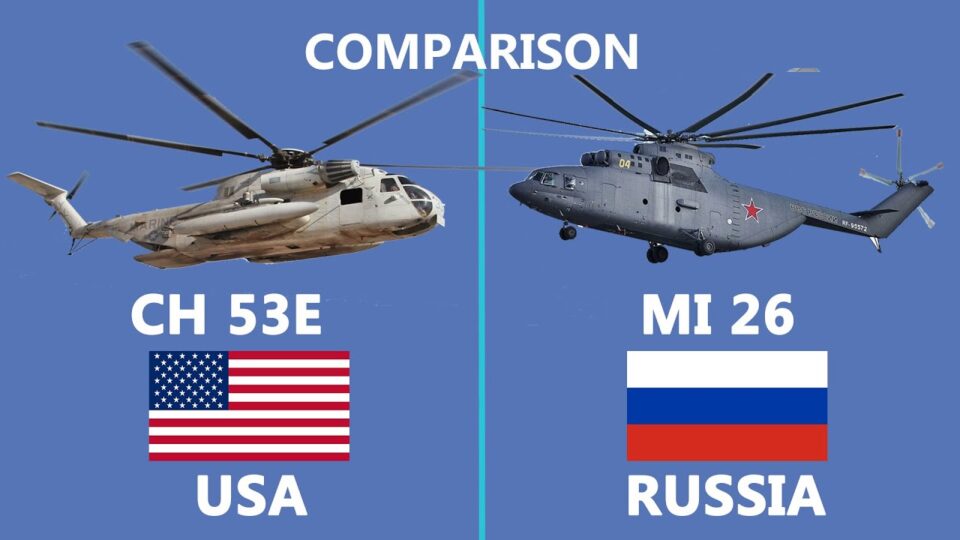
The Mil Mi-26 and the Sikorsky CH-53E Super Stallion are two of the most formidable heavy-lift helicopters in the world, each representing the pinnacle of aviation engineering from their respective countries.
Both helicopters have been integral to military and civilian operations, from transporting troops and equipment to conducting disaster relief missions. This comparison will delve into the design, capabilities, and operational histories of these two engineering marvels, highlighting their unique features and the roles they play in global aviation.
Mil Mi-26, a Soviet/Russian heavy transport helicopter, holds the title of the largest helicopter to have gone into serial production. Distinctively, the Mi-26 is the first factory-equipped helicopter featuring a single, eight-blade main lift rotor. Notably, it possesses the capability to maintain flight even in the event of a power loss in one engine, underscoring its robust design and reliability.
In contrast, The Sikorsky CH-53E Super Stallion is a heavy-lift helicopter operated by the United States military, specifically designed by Sikorsky Aircraft for the United States Marine Corps. This formidable aircraft is engineered to transport up to 55 troops with the installation of seats, showcasing its significant capacity for personnel transport.
Both are two of the most capable heavy-lift helicopters in service today, each excelling in their unique design and operational capabilities. let’s compare both aircraft.
Specification of both Helicopters:
Length
The Mi-26 measures 40.025 meters (131 feet 4 inches) in length, making it significantly longer than the CH-53E, which is 30.188 meters (99 feet 0.5 inches) in length.
Maximum Weight: The Mi-26 has a maximum takeoff weight of 56,000 kg (123,459 lb), while the CH-53E can handle a max takeoff weight of 73,500 lb (33,339 kg).
In terms of ferry range, the Mi-26 achieves an impressive 1,920 km (1,190 mi), while the CH-53E offers 1,830 km (1,140 mi, ).
The Mi-26 has an empty weight of 28,200 kg (62,170 lb), while the CH-53E has highest empty weight of 33,226 lb (15,071 kg).
With a maximum speed of 295 km/h (183 mph), the Mi-26 outpaces the CH-53E, which boasts a maximum speed of 310 km/h (200 mph)
The Mil Mi-26 is equipped with 2 × ZMKB Progress D-136 turboshaft engines, each delivering 8,500 kW (11,400 hp), while the Sikorsky CH-53E Super Stallion boasts 3 × General Electric T64 turboshaft engines, producing 4,380 shp (3,270 kW) each.
The Mi-26 has slightly lower range of 500 km (310 mi) Compared to CH-53E offers highest range of 1,000 km (620 mi,).
The Mi-26 has a service ceiling of 4,600 m (15,100 ft), whereas the CH-53E boasts a higher service ceiling of 18,500 ft (5,600 m).
Mil Mi-26, able to transport oversized cargo such as military vehicles, construction machinery, and even other helicopters with ease. Its payload capacity of up to 20 tonnes allows for the transportation of large equipment in a single trip. Mi-26’s ability to reach remote destinations that are inaccessible to other aircraft is a significant advantage. Whether it’s delivering vital supplies to remote military outposts, supporting humanitarian missions in hard-to-reach areas.
CH-53E Super Stallion is highly proficient in efficiently transporting oversized cargo and equipment. With an impressive payload capacity of up to 16 tonnes, it ranks among the most robust helicopters in the United States Marine Corps (USMC) arsenal. Its primary mission revolves around the transportation of heavy equipment and supplies crucial for amphibious assault operations.
There have been several variants of the Mi-26 developed for different purposes, including troop transport, firefighting, and search and rescue. It has been used by various countries around the world for both military and civilian purposes. It has seen service in conflicts such as the Soviet-Afghan War and has been used for humanitarian missions.
CH-53E has undergone various upgrades and modifications over the years, including the introduction of the MH-53E Sea Dragon variant for countermeasures and the CH-53K King Stallion, which is a newer, more advanced version currently in service with the U.S. Marine Corps. It primarily operated by the United States Marine Corps for heavy-lift missions, and has been deployed in various military operations, including the Gulf War and the Iraq and Afghanistan wars.
