
Aircraft comparison
Comparison of Tejas Mark 2 and Gripen E Fighter Aircraft

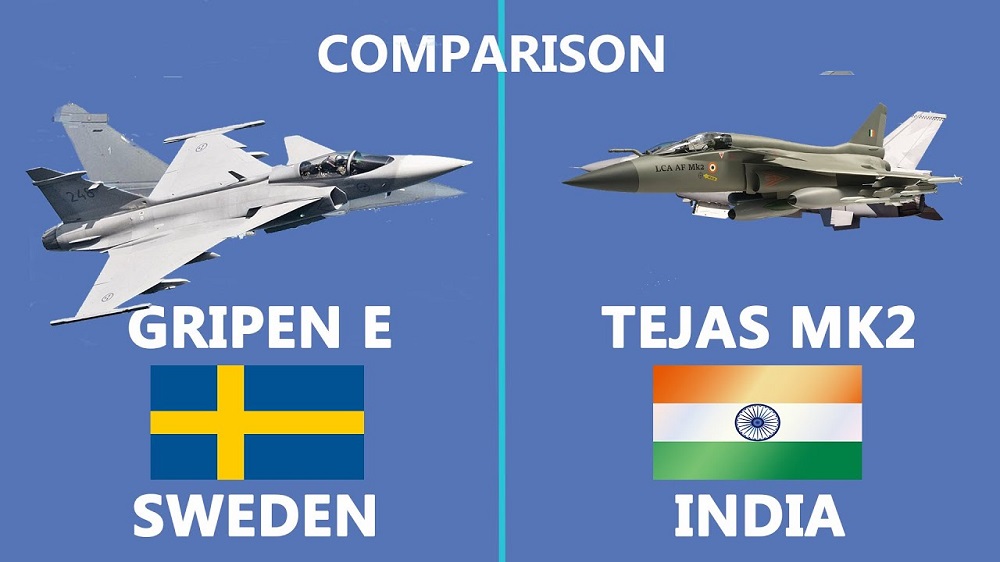
The Tejas Mark 2 and the Gripen E are two advanced fighter aircraft designed to meet the evolving needs of modern air forces.
The Tejas Mark 2, developed by India, represents a significant upgrade over its predecessor, featuring enhanced capabilities and performance. On the other hand, the Gripen, designed by Sweden’s Saab, is known for its versatility and efficiency in various combat scenarios.
These Two Airlines Place Major Orders with Airbus and Boeing
In this article we will compare these two aircraft, examining their specifications, features, and potential roles in the air combat landscape, helping us understand how they stack up against each other.
Length
The Tejas Mk2 measures 14.65 meters (48 feet) in length, while the Gripen E has a slightly greater length of 15,2 meters (51 feet).
Height
The Tejas Mk2 stands at a height of 4.87 meters (16 feet), which is taller compared to the gripen e height is 4.5 meters (14 feet)
Maximum Takeoff Weight (MTOW)
The maximum takeoff weight for the Tejas Mk2 is 17,500 kilograms (38,581 pounds), significantly higher than the JAS 39C/D’s maximum takeoff weight of 16,500kg (36,376 lbs).
Range:
The Tejas Mk2 Light Combat Aircraft (LCA) has a range of 3,000 kilometers (1,900 miles), while the Saab Gripen E boasts a slightly higher maximum range of approximately 3,200 kilometers (about 1,988 miles).
Fuel Capacity
The Tejas Mk2 has a fuel capacity of 3,400 kilograms (7,500 pounds) internally. In comparison, the gripen e has an internal fuel capacity slightly lower 2,500 kg (about 5,511 lbs).
Powerplant and Thrust
The Tejas Mk2 is powered by a General Electric F414-INS6 afterburning turbofan engine, producing 57.8 kN (13,000 lbf) of thrust dry. In contrast, the gripen e utilizes a Volvo Aero RM12 afterburning turbofan engine, which provides 80 kN (18,000 lbf) of thrust.
Maximum Speed
The Tejas Mk2 can achieve a maximum speed of Mach 1.8, while the gripen E outpaces it with a maximum speed of Mach 2.
Service Ceiling
The service ceiling of the Tejas Mk2 is higher which is 17,300 meters (56,758 feet), compared to the JAS 39C/D’s service ceiling of 15,000 meters (49,200 feet).
When it comes to radar capabilities, the Gripen e boasts a highly advanced system. Similarly, the LCA Mk2 is poised to be equipped with a top-tier AESA radar until the Uttam radar, which has a range of 150 kilometers, is ready. Israel has already proposed the ELTA 2052 radar; however, India has issued a tender for this system with a focus on technology transfer (TOT). Consequently, India will either acquire the ELTA 2052 or a more advanced radar, ensuring that it will not fall short in performance compared to the Gripen’s radar.
The tejas Mark 2 is equipped with a diverse range of missiles that cater to various combat scenarios: For air-to-air combat, it will carry advanced missiles like the MICA and Meteor for long-range targeting. The ASRAAM will help with close-range defense, while the Astra, still being developed, will improve dogfighting abilities. The aircraft will also integrate the NG-CCM for added air superiority.
Boeing Resumes Wide-Body Aircraft Production after Strike
The Gripen E is equipped with various air-to-air missiles, including the infrared-guided IRIS-T and the beyond visual range Meteor. It can also carry Sidewinder and A-Darter missiles as alternatives to the IRIS-T, and AMRAAM to replace the Meteor. Additionally, it can be fitted with long-range weapons like R-Darter and Derby, and short-range options such as ASRAAM and Python.
The tejas mk2 will feature a night vision goggles-compatible glass cockpit dominated by a touch-sensitive wide area display arranged in panoramic orientation, complemented by a wide-angle holographic head-up display system. It will adopt a hands-on throttle-and-stick arrangement with the stick on the right-hand side and throttle on the left-hand side, designed to reduce pilot workload.
Airbus Secures 650,000 Sq Ft Office in Bengaluru for 10 Years
When compared to previous Gripen models, the Gripen E boasts a vastly enhanced avionics system. The Gripen E will meet the rigorous operational requirements of air forces in the twenty-first century. The Gripen was designed to have a long service life of roughly 50 years with minimal maintenance requirements. The Gripen was designed to be adaptable, allowing for the addition of new sensors, processors, and weaponry as technology advanced.
The Gripen E features landing gear positioned further from its main fuselage and closer to its wings, enabling it to support 10 pylon stations. This design allows the aircraft to carry more weapons in a single sortie. Additionally, the use of missile eject launcher pylons under the Gripen E’s belly facilitates the installation of extra pylon stations.
In contrast, the LCA Mk2 will have 8 pylon stations, similar to the Mk1 airframe, and is not expected to undergo significant changes in landing gear positioning to accommodate additional pylon stations like those on the Gripen E.
