
Aviation
Comparison of Sweden’s Gripen and France’s Rafale Fighter Jets

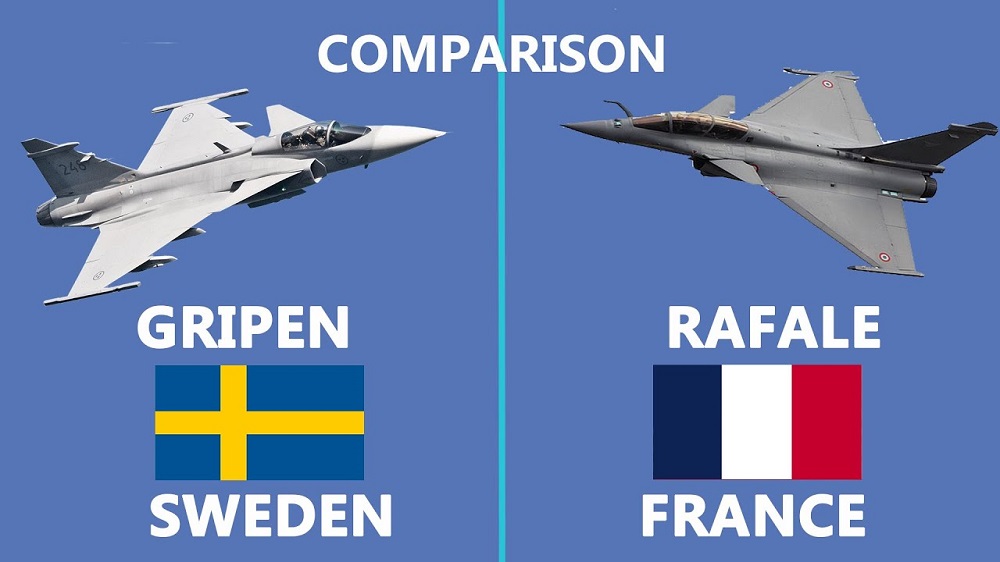
The JAS-39 Gripen and Dassault Rafale are two advanced fighter jets known for their versatility and performance.
The Gripen, developed by Sweden, is designed for agility and cost-effectiveness, making it ideal for smaller air forces. In contrast, the Rafale, from France, boasts greater power and capabilities for multi-role missions, including air-to-air and air-to-ground combat.
In this comparison we will highlight their key features, strengths, and intended roles in modern air warfare.
Comparison of Bombardier Global 7500 Vs Gulfstream G700
The Gripen, is a light single-engine multirole fighter made by Saab in Sweden. It also has a delta wing and canard design, focusing on agility and cost-effectiveness. The Gripen is equipped with modern fly-by-wire controls and is fully interoperable with NATO systems.
The Rafale on the other hand,is a French twin-engine multirole fighter jet designed by Dassault Aviation. It features a canard delta wing and is capable of various missions, including air supremacy, ground support, reconnaissance, and nuclear deterrence. Known as an “omnirole” 4.5th generation aircraft, it can engage in a wide range of combat scenarios.
Here’s is the comparsion of both aircraft
- Length: The Gripen is 15.2 meters (49 ft) long, while the Rafale is slightly longer at 15.27 meters (50 ft).
- Maximum Takeoff Weight: Gripen has a max takeoff weight of 16,500 kg (36,376 lb), whereas the Rafale can handle up to 24,500 kg (54,013 lb), indicating a higher payload capacity.
- Fuel Capacity: Gripen carries 4,360 liters (3,400 kg) of internal fuel, while the Rafale has a larger internal fuel capacity of 4,700 kg for the single-seater and 4,400 kg for the two-seater.
- Powerplant: Gripen is powered by a single General Electric F414-GE-39E engine, producing up to 98 kN (22,000 lbf) of thrust with afterburner. The Rafale uses two Snecma M88-4e engines, generating 75 kN (17,000 lbf) of thrust each with afterburner.
- Maximum Speed: Gripen can reach a top speed of Mach 2 (2,100 km/h or 1,300 mph), while the Rafale has a slightly lower maximum speed of Mach 1.8 (1,912 km/h or 1,188 mph).
- Combat Range: The Rafale has a longer combat range of 1,850 km (1,150 mi) compared to Gripen’s 1,500 km (930 mi), allowing for extended missions.
- Hardpoints: Gripen offers 10 hardpoints for weapons and equipment, while the Rafale provides more versatility with 14 external hardpoints.
The Gripen E features landing gear positioned further from its main fuselage and closer to its wings, enabling it to support 10 pylon stations. This design allows the aircraft to carry more weapons in a single sortie. Additionally, the use of missile eject launcher pylons under the Gripen E’s belly facilitates the installation of extra pylon stations.
Flydubai Cancels Flights to Two Russian Cities Until January
Rafale was meticulously crafted with reduced radar cross-section (RCS) and infrared signature in mind. Modifications from the initial technology demonstrator include tail-fin size reduction, fuselage reshaping, repositioning of engine air inlets beneath the wing, and extensive use of composite materials. Seventy percent of the Rafale’s intake surface area consists of composites, enhancing its stealth capabilities. However, many features aimed at minimizing the Rafale’s visibility to threats remain classified.
Apply Now for 840 AAI ATC Vacancies in 2024
In terms of armament versatility, the Gripen features a flexible store management system that allows easy integration of a wide range of weapons and equipment, making it compatible with NATO standards. It has 10 hardpoints, which can carry a variety of air-to-air, air-to-ground, and anti-ship missiles, as well as auxiliary fuel tanks for extended range. The Gripen is also equipped with a 27 mm Mauser BK-27 cannon and can be configured with laser-guided bombs, precision-guided munitions, and other advanced weapon systems, enabling it to handle diverse combat missions.
While the Rafale utilizes a store management system compliant with MIL-STD-1760, facilitating seamless integration of various weapons and equipment. With 14 hardpoints (13 on the Rafale M version), including five suitable for heavy armaments or auxiliary fuel tanks, the rafale vs su 35 Rafale boasts a maximum external load capacity of nine tons. Additionally, it is armed with the 30 mm GIAT 30 revolver cannon and can be configured with an array of laser-guided bombs and ground-attack munitions.
