
Aircraft comparison
Comparison of Russian Su30 and France built Rafale fighter jet

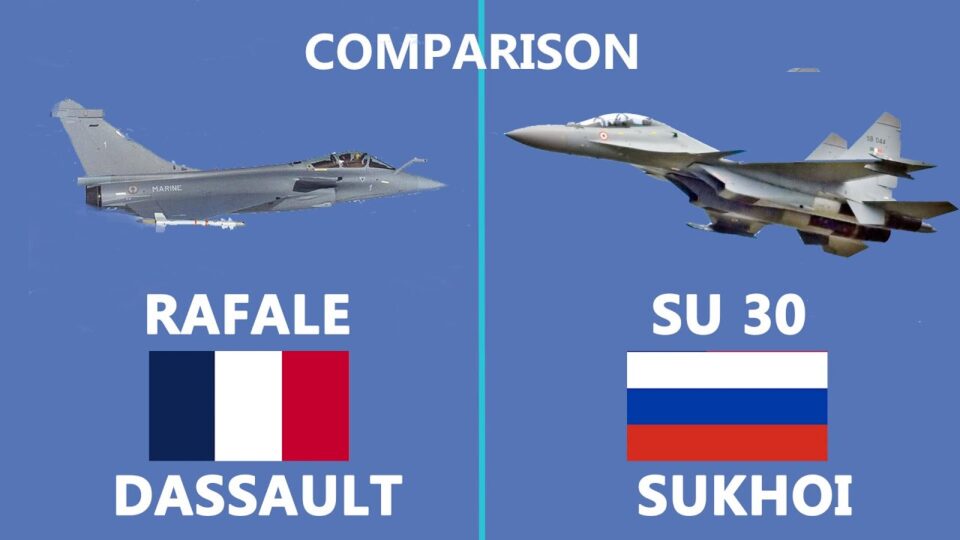
The Su-30 and Rafale are two prominent multirole fighter aircraft that have garnered significant attention in the global defense community. The Su-30, developed by Russia’s Sukhoi, is renowned for its versatility and advanced avionics, while the Rafale, produced by France’s Dassault Aviation, is celebrated for its agility and cutting-edge technology.
In this article, we will compare both fighters, examining their design, technological advancements, and operational capabilities to understand how they stack up against each other in the competitive landscape of modern aerial warfare.
The Sukhoi Su-30 is a Russian fighter jet with two engines and seats for two pilots. It’s designed to fly in all weather and perform air-to-air and ground attacks. It can fly with autopilot and use radar to navigate at low altitudes. The Su-30 can attack both air and ground targets alone or in groups. As of 2024, about 600 of these jets have been built.
The Rafale, is highly versatile, boasting advanced avionics and a wide array of weapons capability. Its design prioritizes agility and adaptability, making it effective in various combat scenarios. As of 2023, approximately 259 Rafale jets have been built, showcasing its significant role in modern air warfare.
Both the Su-30 and Rafale are advanced multirole fighters, each with unique capabilities and design philosophies.
Length:
- The Su-30 measures 21.935 meters (72 feet ) in length, whereas the Rafale is shorter at 15.27 meters (50 feet).
Wingspan:
- The Su-30 has a wingspan of 14.7 meters (48 feet), which is notably wider compared to the Rafale’s wingspan of 10.90 meters (35 feet ).
- Max Takeoff Weight:
- The Su-30’s maximum takeoff weight is 34,500 kilograms (76,059 pounds), significantly higher than the Rafale’s maximum takeoff weight of 24,500 kilograms (54,013 pounds).
- Powerplant:
- The Su-30 is powered by two Saturn AL-31FL/FP turbofan engines, each providing 74.5 kN (16,700 lbf) thrust dry and 122.58 kN (27,560 lbf) with afterburner. In contrast, the Rafale uses two Snecma M88-4e turbofan engines, delivering 50.04 kN (11,250 lbf) thrust dry and 75 kN (17,000 lbf) with afterburner.
- Rate of Climb:
- The Su-30 has a rate of climb of 230 meters per second (45,000 feet per minute), while the Rafale boasts a superior rate of climb at 304.8 meters per second (60,000 feet per minute).
- Maximum Speed:
The Su-30 can reach speeds of up to 2,120 km/h (1,320 mph, Mach 2) at high altitude, while the Rafale has a maximum speed of 1,912 km/h (1,188 mph, Mach 1.8). - The Su-30 has a service ceiling of 17,300 meters (56,800 feet), exceeding the Rafale’s service ceiling of 15,835 meters (51,952 feet).
The Su-30 is renowned for its robust airframe, exceptional maneuverability in all axes, and its iconic “cobra” maneuver. The tactical effectiveness of the cobra maneuver has been a topic of debate for decades, with no clarity its practical application. Designed originally for ground-attack roles, the series incorporates features such as canards, thrust-vectoring engines, and a long-range phased-array radar to excel in air-superiority missions.
Meanwhile, the Rafale was meticulously crafted with reduced radar cross-section (RCS) and infrared signature in mind. Modifications from the initial technology demonstrator include tail-fin size reduction, fuselage reshaping, repositioning of engine air inlets beneath the wing, and extensive use of composite materials. Seventy percent of the Rafale’s intake surface area consists of composites, enhancing its stealth capabilities. However, many features aimed at minimizing the Rafale’s visibility to threats remain classified.
In terms of armament versatility, the Su-30 is equipped with a robust store management system that allows for the integration of a wide range of weapons and equipment. The Su-30 features 12 hardpoints for mounting various ordnance, including air-to-air missiles, air-to-ground missiles, and bombs. Additionally, it is armed with a 30 mm GSh-30-1 cannon, and it can be armed with a diverse array of weapons such as the R-27 and R-77 air-to-air missiles, precision-guided munitions, and various types of bombs.
While the Rafale utilizes a store management system compliant with MIL-STD-1760, facilitating seamless integration of various weapons and equipment. With 14 hardpoints (13 on the Rafale M version), including five suitable for heavy armaments or auxiliary fuel tanks, the rafale vs su 35 Rafale boasts a maximum external load capacity of nine tons. Additionally, it is armed with the 30 mm GIAT 30 revolver cannon and can be configured with an array of laser-guided bombs and ground-attack munitions.
