
Defence
Top 10 Legendary Aircraft Still Flying After Decades
From WWII icons like the Mosquito and B-17 to Cold War giants like the Tu-95 and B-52, these aircraft prove that great designs never truly retire.

In aviation, some aircraft are more than just machines—they become legends. While newer, faster, and more advanced jets continue to dominate the skies, a select few aircraft have defied time, technology, and even retirement orders.
From Cold War icons still patrolling modern skies to passenger planes that keep flying long after successors arrived, these enduring machines prove that true workhorses never really fade away.
Here’s a look at the Top 10 Aircraft That Refused to Retire, still making history decades after their first flight.
1. Boeing B-52 Stratofortress (1952)
- Unique Features: Long-range heavy bomber with intercontinental reach, capable of carrying nuclear and conventional weapons. Famous for unmatched endurance and continuous upgrades.
- Production: 742 built between 1952–1962.
- Service & Uses: Still flown by the U.S. Air Force, with 76 active as of 2024. Modernization programs (new engines, avionics) will keep it in service into the 2050s, making it one of the longest-serving combat aircraft in history.
2. Tupolev Tu-95 “Bear” (1952)
- Unique Features: Strategic bomber powered by four Kuznetsov NK-12 turboprops with contra-rotating propellers—one of the fastest propeller aircraft ever. Long-range cruise missile carrier and maritime patrol platform.
- Production: Over 500 built since the 1950s.
- Service & Uses: Still active with the Russian Air Force, regularly patrolling Arctic and Pacific regions. Expected to serve until the 2040s.
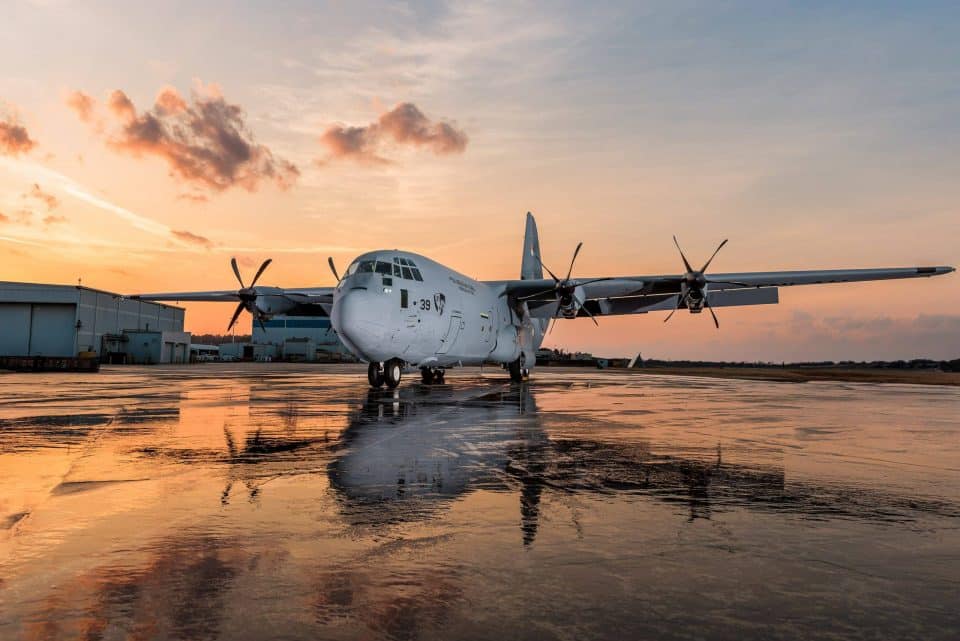
3. Lockheed C-130 Hercules (1954–present)
- Unique Features: Four-engine turboprop transport with unmatched versatility; capable of operating from unprepared runways. Variants include cargo transport, aerial refueling, gunship (AC-130), firefighting, and weather reconnaissance.
- Production: Over 2,500 built across more than 70 variants.
- Service & Uses: In service with 63 countries, from military resupply to humanitarian aid. Still in production as the C-130J Super Hercules.
4. Fairchild Republic A-10 Thunderbolt II (1972)
- Unique Features: Nicknamed the “Warthog,” it was built around the massive 30 mm GAU-8 Avenger cannon. Armored, rugged, and designed for Close Air Support (CAS) against tanks and ground forces.
- Production: 716 built; around 282 A-10C upgraded models remain in USAF service (as of 2017).
- Service & Uses: Exclusively used by the U.S. Air Force, famous for its survivability and ability to loiter over battlefields. Scheduled to remain in service until at least the late 2030s.
5. Grumman F-14 Tomcat (1970)
- Unique Features: Twin-engine naval fighter with variable-sweep wings and long-range AIM-54 Phoenix missiles, designed for fleet defense. Featured advanced radar and combat systems.
- Production: 712 built (1969–1991).
- Service & Uses: Operated by the U.S. Navy until 2006. Still flown by Iran, which acquired them before the 1979 revolution and keeps them operational with local upgrades.
6. Mil Mi-24 “Hind” (1969)
- Unique Features: A unique blend of attack helicopter and armored troop transport—nicknamed the “flying tank.” Equipped with rockets, cannons, and anti-tank missiles, while carrying up to 8 troops.
- Production: More than 2,300 built since 1969.
- Service & Uses: Operated by over 50 countries, still active in Russia, India, and several African nations. Widely used in conflicts from Afghanistan to Ukraine.
7. Douglas C-47 / DC-3 (1935)
- Unique Features: Revolutionary twin-engine transport aircraft, adapted from the DC-3 civilian airliner. Known for reliability, simplicity, and ability to operate from rough fields.
- Production: Civilian DC-3: 607 built; with military and licensed versions (C-47, Li-2, etc.): 16,000+ produced.
- Service & Uses: Used heavily in WWII (paratroop drops, cargo). Even today, ~150 DC-3s remain in service worldwide for cargo and bush flying.
8. Boeing B-17 Flying Fortress (1938)
- Unique Features: Iconic four-engine heavy bomber of WWII, renowned for defensive armament and ability to return home despite severe battle damage.
- Production: 12,731 built between 1936–1945.
- Service & Uses: Extensively used by the U.S. Army Air Forces in Europe and the Pacific. Today, only a handful remain airworthy, flying in heritage and airshow roles.
9. Republic P-47 Thunderbolt (1941)
- Unique Features: One of the heaviest fighter-bombers of WWII, powered by the Pratt & Whitney R-2800 engine. Famous for durability, eight .50 cal machine guns, and ground-attack effectiveness.
- Production: 15,683 built.
- Service & Uses: Used by U.S. Army Air Forces and Allies in both Europe and the Pacific. Phased out post-WWII, but remembered as one of the most rugged fighters ever built.
10. de Havilland Mosquito (1940)
- Unique Features: Nicknamed the “Wooden Wonder,” it was built mostly of wood, making it light, fast, and difficult to detect on radar. Served as a bomber, fighter, reconnaissance aircraft, and night-fighter.
- Production: 7,781 built in total.
- Service & Uses: Flown by the RAF and Allied nations during WWII. Its versatility and speed made it one of the most effective multi-role aircraft of its time.
For more aerospace news, check out JetlineIntel.
Want to buy aviation merchandise? Visit Jetshop.in.
To read Jetlinemarvel’s updates on Google News, head over to Google News.
