
Aircraft comparison
Comparison of BAE Systems Hawk By UK and HAL HJT 36 Yashas by India Trainer aircraft
The BAE Hawk and HAL HJT-36 Yashas follow different paths—one a proven global leader, the other an emerging indigenous contender—but both share the mission of training tomorrow’s fighter pilots.

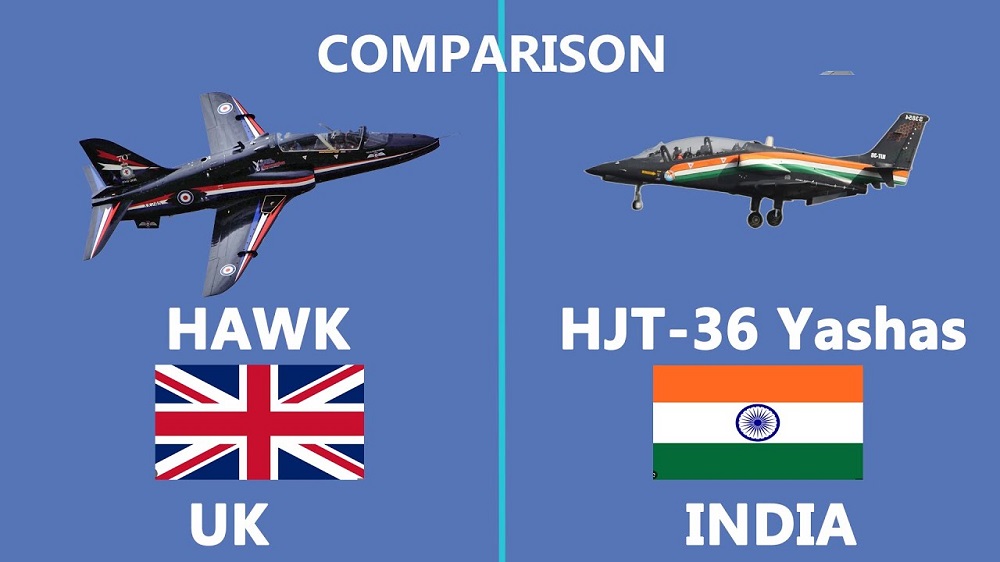
In the ever-evolving world of military aviation, trainer aircraft play a crucial role in shaping the next generation of fighter pilots.
Among the notable names in this category stand two remarkable jets — the BAE Systems Hawk, a combat-proven British trainer used by air forces across the globe, and India’s homegrown challenger, the HAL HJT-36 “Yashas”, a bold step toward self-reliance in pilot training.
While the Hawk has decades of legacy and combat-readiness on its side, the HJT-36 represents India’s ambition to break free from foreign dependence with an indigenous solution tailored for intermediate jet training.
But how do these two trainer aircraft truly compare in terms of performance, technology, and strategic value? Let’s dive into an in-depth comparison of the BAE Hawk and HAL HJT-36 Yashas — two jets with different origins but a shared mission: to train the fighters of tomorrow.
The Hawk 128 is a more powerful and combat-ready advanced jet trainer, equipped with Rolls-Royce Adour Mk. 951 turbofan, delivering 29 kN of thrust and equipped with FADEC for optimized performance.
While,The HJT-36 Yashas in production form uses the NPO Saturn AL-55I turbofan, generating 17.3 kN of thrust — significantly lower than the Hawk.
In terms of range, the Hawk again leads with a remarkable 2,520 km, more than double the Yashas’s operational range of 1,000 km. This extended reach allows the Hawk to perform longer training sorties without refueling, offering a broader training envelope.
When it comes to altitude, the Hawk soars higher with a service ceiling of 13,565 meters (44,500 ft), outperforming the HJT-36’s 9,000 meters (29,520 ft).
When it comes to payload, the Hawk carries a heavier load, with a useful load of 3,000 kg and a maximum takeoff weight of 9,100 kg. The HJT-36, on the other hand, is designed with a lighter maximum takeoff weight of 5,400 kg, suiting its intermediate trainer role.
The Hawk 128 outperforms with a maximum speed of Mach 0.84 (1,028 km/h), compared to the HJT-36’s Mach 0.75 (750 km/h).
The HJT-36 Yashas, designed to replace India’s HJT-16 Kiran, is still in the trial and certification phase, with HAL prioritizing its trainer role for the Indian Air Force before exploring export as a light attack jet.
In contrast, the Hawk, particularly the T2 and Mk.167 variants, is a mature platform with decades of operational use by air forces like the RAF, RAAF, and others. Recent Hawk updates include augmented reality integration (ATARS) and ongoing support contracts, with replacement discussions underway for the 2030s.
Avionics & Combat Capabilities
The Hawk 128 comes equipped with glass cockpits, modern avionics, and compatibility with precision-guided munitions such as Brimstone missiles and ASRAAM, giving it credible light combat capabilities in addition to its training role.
The Yashas, while more limited, includes five hardpoints and supports a 1,000 kg payload, suitable for carrying short-range missiles like ASRAAM or R-73 for counter-insurgency and surveillance roles. However, the compact nose cone of the HJT-36 restricts radar integration, limiting its potential for advanced combat simulation.
Operational Status & Maturity
The Hawk is a mature platform, with decades of service in air forces such as the RAF, RAAF, and others. Over 25,000 pilots have been trained on the Hawk globally, making it the most widely used advanced jet trainer in the world.
In comparison, the Yashas is still undergoing trials and certification, with HAL focusing on its deployment in the Indian Air Force before pursuing export opportunities.
Export Potential & Market Strategy
HAL is actively exploring the conversion of the HJT-36 into a cost-effective light attack aircraft for export. The goal is to address the needs of countries looking for affordable platforms for low-intensity operations, like counter-terrorism, border patrol, and internal security in uncontested airspace.
The Hawk, already in service with countries like Saudi Arabia, Oman, and Qatar, benefits from global support systems, modernization packages, and a robust upgrade roadmap — although its higher cost reflects these advanced features.
Conclusion: Two Jets, One Mission – Different Paths
The BAE Hawk stands tall as a global benchmark in jet trainer aircraft, combining speed, payload, and real-world combat readiness in a time-tested platform. On the other hand, the HAL HJT-36 Yashas represents India’s stride toward indigenization, with a focus on affordability, simplicity, and regional utility.
While the Hawk dominates in performance and maturity, the Yashas has potential in the growing export market for low-cost light attack jets, particularly as HAL works to evolve its capabilities.
Both aircraft ultimately serve a common purpose — training the fighter pilots of tomorrow, with one built on legacy, and the other powered by national ambition.
For more aerospace news, check out JetlineIntel.
Want to buy aviation merchandise? Visit Jetshop.in.
To read Jetlinemarvel’s updates on Google News, head over to Google News.
