
Aviation
Top 10 Stealth Jets of 2030: The Future of Air Dominance
This article examines the top 10 stealth fighters expected to dominate the skies by 2030, highlighting their capabilities, production outlook, and the future of AI-powered air combat.

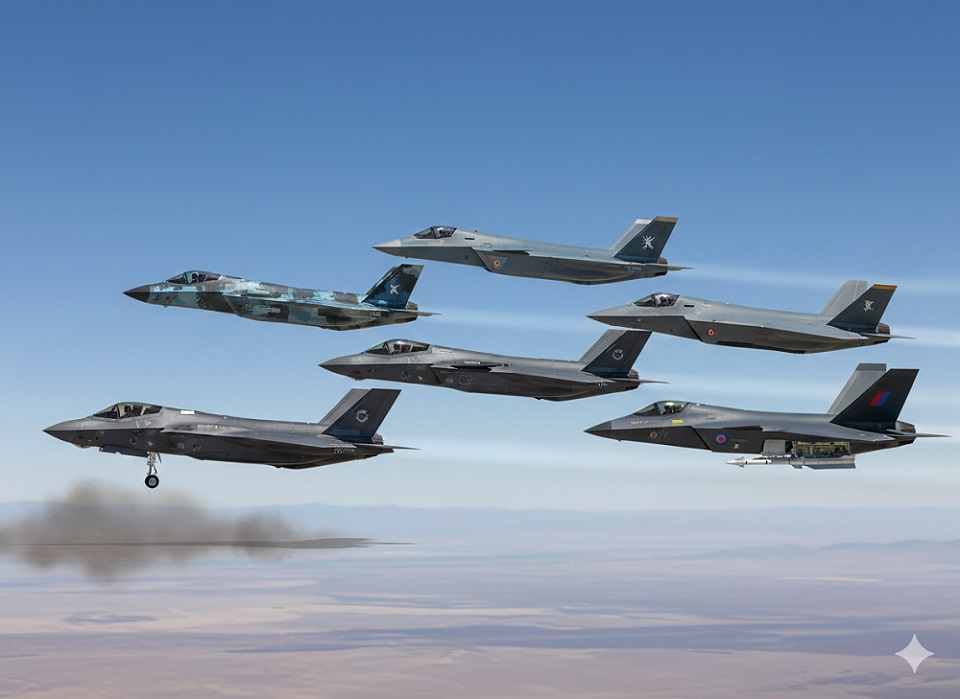
By 2030, the global fighter landscape will be transformed by the rapid evolution of stealth aircraft, artificial intelligence, long-range sensors, and manned–unmanned teaming.
Fifth-generation fighters—built around low observability, advanced avionics, internal weapons carriage, and sensor fusion—will dominate operational fleets, while early sixth-generation prototypes begin shaping future air warfare.
The United States leads with battle-tested stealth platforms, but China is aggressively narrowing the gap with massive J-20 production. Russia’s Su-57 continues refining its design, while new entrants like South Korea’s KF-21 and India’s AMCA represent emerging aerospace powerhouses.
Our top-10 ranking for 2030 is based on stealth performance (RCS), avionics/AI integration, supercruise, range, payload capacity, production scale, and operational readiness. Here are the fighters that will define air dominance in 2030.
1. F-35 Lightning II — USA
The F-35 remains the most widely deployed stealth fighter in the world, with over 2,500 units projected by 2030. It features an RCS as low as 0.001 m², a top speed of Mach 1.6, MTOW of 31,800 kg, and a combat range of 670 nm. Block 4 upgrades—including the AN/APG-85 radar, enhanced EW systems, and AI-assisted targeting—will significantly improve lethality. Although sustainment costs remain its drawback, the F-35’s unmatched sensor fusion, global interoperability, and proven combat data secure its #1 position.
2. F-22 Raptor (Upgraded) — USA
The F-22, even as an aging platform, will remain the world’s premium air-superiority fighter. With an RCS of 0.0001 m², top speed of Mach 2.25, MTOW of 38,000 kg, and a combat range of 460 nm, the upgraded fleet will integrate NGAD-derived processors and advanced EW suites. Its thrust-vectoring engines and supercruise ability make it unbeatable in a dogfight. The only limitation is its small fleet—around 180 aircraft—due to halted production and no export program.
3. J-20 Mighty Dragon — China
China’s J-20 will be the most rapidly expanding stealth fleet with 800–1,000 units expected by 2030. Powered by the new WS-15 engines, it can reach Mach 2+, supercruise, and delivers a combat range of 1,100 nm, with MTOW around 37,000 kg. Its RCS is estimated between 0.02–0.1 m². The J-20’s strengths include long-range BVR engagement, advanced datalinks, and future integration of hypersonic missiles. While combat experience remains untested, mass production and growing AI capabilities make it a formidable Indo-Pacific challenger.
4. Su-57 Felon (Su-57M) — Russia
Russia’s Su-57M boasts exceptional maneuverability due to 3D thrust vectoring and a powerful AL-51F1 engine upgrade. It reaches Mach 2, carries a combat range of 930 nm, and has an MTOW of 35,500 kg, though stealth performance (RCS 0.1–0.5 m²) trails U.S. and Chinese rivals. By 2030, Russia may field 76–100 aircraft. Its strengths lie in agility, internal missile capacity, and AI pilot assist systems, while weaknesses include production delays and supply-chain constraints due to sanctions.
5. KF-21 Boramae Block III — South Korea
South Korea’s KF-21 will transition into a true 5th-gen aircraft with internal weapons bays by the early 2030s. With a projected RCS of ~0.1 m², it reaches Mach 1.8, has MTOW 25,600 kg, and a combat range of 880 nm. The KF-21 offers an excellent cost-to-capability ratio, equipped with an indigenous AESA radar and advanced EW suite. Around 120+ aircraft are expected by 2030. Its primary drawback is its semi-stealth origin, but export potential and affordability make it a rising star.
6. AMCA — India
India’s AMCA program aims for its first flight around 2028, entering service late in the decade. With an MTOW of 27,000 kg, combat range of 870 nm, maximum speed of Mach 1.8, and projected RCS around 0.01 m², AMCA will feature supercruise capability, AI-enabled avionics, and meta-material stealth design. Fleet size may reach 40–100 units by 2030. Its main challenges are engine co-development and timelines, but it represents a major leap toward Indian aerospace self-reliance.
7. NGAD (Demonstrator) — USA
The U.S. NGAD (Next Generation Air Dominance) won’t be fully operational by 2030, but early demonstrators will showcase 6th-generation capabilities. Expected to feature <0.001 m² RCS, adaptive-cycle engines, and Mach 2+ supercruise, NGAD will offer a combat range of 1,000+ nm and large internal payload options. With around 10–20 prototypes, it serves as a gateway to AI co-pilots and loyal wingman drones. Its biggest limitation is extremely high unit cost.
8. GCAP/Tempest — UK–Italy–Japan
The GCAP fighter (combining UK Tempest and Japan F-X) will see early prototypes by the late 2020s. It aims for <0.01 m² RCS, Mach 2+ speed, 1,000 nm range, and large MTOW supporting heavy internal payloads plus drone teaming. Around 5–10 demonstrators may fly by 2030. GCAP’s open-architecture design allows rapid upgrades, but major challenges include multinational engineering coordination and an IOC target beyond 2035.
9. TF Kaan — Turkey
Turkey’s TF Kaan is designed as a cost-effective fighter with moderate stealth capabilities. It will feature an RCS of 0.5–1 m², top speed of Mach 1.8, MTOW around 34,750 kg, and combat range of 760 nm. Estimated fleet size by 2030 is 20–50 aircraft. Its strengths include indigenous AESA radar, multirole flexibility, and competitive pricing. Engine dependency and limited low-observability characteristics place it lower in the ranking.
10. J-35 — China (Carrier-Based)
The J-35 will serve as China’s primary carrier-borne stealth fighter by 2030, complementing the J-20. With an estimated RCS of 0.05 m², top speed of Mach 1.8, MTOW of 30,000 kg, and combat range around 670 nm, it integrates the new WS-19 engine. Production may exceed 200 units. While its naval role expands China’s blue-water capabilities, challenges include carrier integration and untested export potential.
Conclusion
By 2030, stealth fighters will be judged less by dogfight performance and more by AI integration, networked warfare, and drone teaming. The F-35 leads due to global scale, while the J-20’s mass production reshapes Asia’s air power balance. New programs like AMCA and KF-21 signal the rise of next-generation aerospace nations. Meanwhile, NGAD and GCAP hint at a 6th-generation future where data, autonomy, and system-of-systems warfare define aerial dominance.
For more aerospace news, check out JetlineIntel.
Want to buy aviation merchandise? VisitJetshop.in.
To read Jetlinemarvel’s updates on Google News, head over to Google News.
