
Aviation
Airbus’ “BLADE” laminar flow wing demonstrator makes first flight

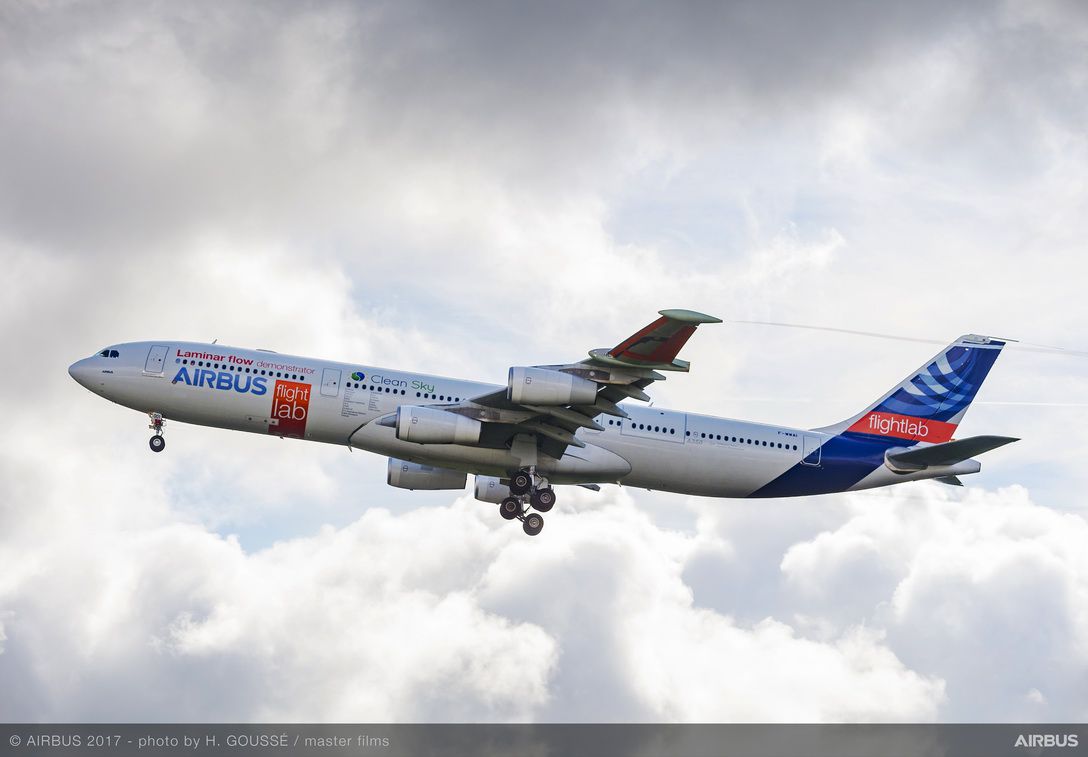
Toulouse, September 26th, 2017 – Airbus’ A340 laminar-flow “BLADE” test demonstrator aircraft (A340-300 MSN001) has made its successful maiden flight for the EU-sponsored Clean Sky “Blade” project. The aircraft, dubbed “Flight Lab”, took off from the Tarbes aerodrome in southern France at local time 11:00, and after a series of successful tests it landed at Airbus’ facilities in Toulouse Blagnac. The overall flight time was 3hrs/38mins.
The BLADE project – which stands for “Breakthrough Laminar Aircraft Demonstrator in Europe” – is tasked with assessing the feasibility of introducing the technology for commercial aviation. It aims to improve aviation’s ecological footprint, bringing with it a 50% reduction of wing friction and up to five percent lower CO2 emission. Airbus’ A340 Flight Lab is the first test aircraft in the world to combine a transonic laminar wing profile with a true internal primary structure.
On the outside the aircraft is fitted with two representative transonic laminar outer-wings, while inside the cabin a highly complex specialist flight-test-instrumentation (FTI) station has been installed. The extensive modifications to the A340-300 test-bed aircraft took place during the course of a 16-month working party in Tarbes, with the support of numerous industrial partners across Europe. Today’s first-flight marks the kick-off of the Blade flight-test campaign to explore the wing’s characteristics in flight.
Airbus’ C295 Flight Test Bed 2 takes to the skies for the first time.
“We began by opening the flight envelope to check that the aircraft was handling correctly,” explains Airbus Flight-Test Engineer, Philippe Seve, who was on board the flight. “We achieved our objective to fly at the design Mach number, at a reasonable altitude and check everything was fine. We also checked that the FTI was working as expected, to identify further fine-tuning for the next flights.”
Airbus begins deliveries of first A350s with touchscreen cockpit displays option to customers
In the run-up to the start of this flight-testing phase, a small team of 10 specially trained pilots, test engineers and flight test engineers had prepared for this milestone for several months, spending time in a simulator and familiarising themselves with the FTI systems to be installed on the Airbus flight-test aircraft. Moreover, on equipment installation side, a working party of 70 people performed the FTI installation inside the aircraft, while teams from Bremen, Germany and Broughton, UK worked externally on the outer wings, with a team from Stade Germany, installing a pod containing infrared cameras on the fin.
